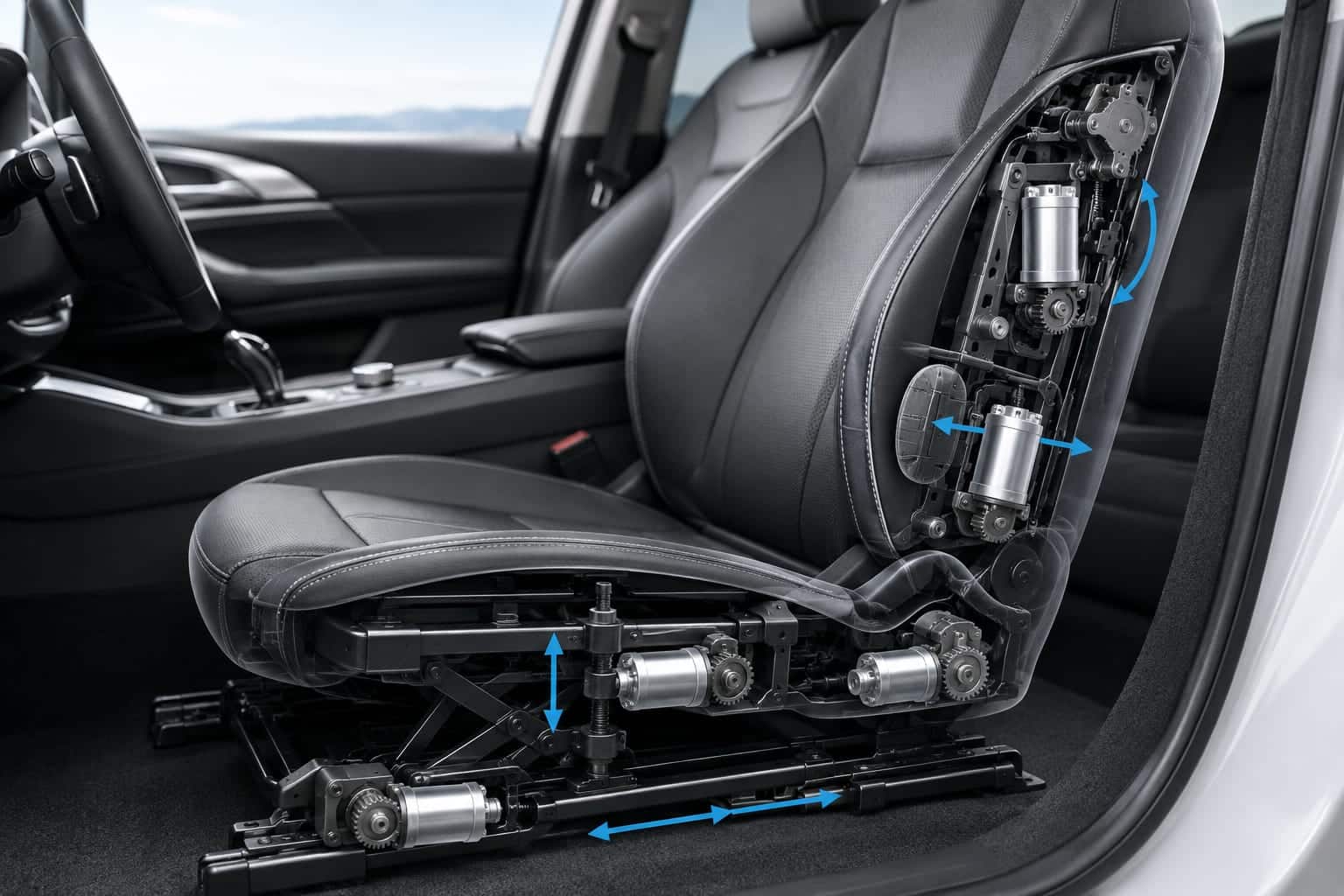
Automotive seat adjustment systems are no longer simple mechanical structures. In modern vehicles, especially passenger cars, SUVs, luxury vehicles, electric vehicles, and commercial vehicles, seats must provide comfort, safety, precision, and convenience. Drivers and passengers expect smooth forward-backward movement, height adjustment, backrest reclining, lumbar support, and memory position control. To achieve these functions reliably, automotive seat systems need compact and powerful gear motors.
What Does a Gear Motor Do in a Car Seat?
A gear motor uses a gearbox to lower speed and increase motor torque. This makes it suitable for moving seat mechanisms that require controlled force rather than high speed.
In automotive seat adjustment systems, gear motors are commonly used for:
| Seat Function | Gear Motor Role |
|---|---|
| Seat sliding | Moves the seat forward and backward |
| Seat height adjustment | Adjusts seat cushion height |
| Backrest reclining | Adjusts the seatback angle |
| Lumbar support | Controls support pressure and position |
| Seat tilt adjustment | Changes cushion angle for comfort |
| Memory seat system | Returns the seat to saved positions |
Compact Gear Motors Deliver High Torque
Car seats must move the weight of passengers, seat frames, rails, cushions, and internal mechanisms. A standard motor may rotate quickly, but it may not provide enough torque for stable seat movement. A gear motor increases torque by slowing motor speed through gear reduction.
This matters because automotive seats offer very limited mounting space. The motor must fit inside or under the seat without affecting design, comfort, or safety. Gear motors offer a compact structure while still delivering strong driving force.
Seat Adjustment Requires Smooth and Controlled Motion
A car seat should not move too fast or stop suddenly. If the movement is rough, it affects user comfort and may also damage the seat mechanism over time. Gear motors regulate speed for smoother, more stable seat adjustment.
For example, when a driver adjusts the backrest angle, the motor must move gradually and accurately. Gear reduction helps create this controlled movement, improving the overall user experience.
Gear Motors Improve Position Accuracy
Modern vehicles often include memory seat functions. The seat can automatically return to a saved position based on the driver’s preference. This requires accurate motion control.
Gear motors help the system move the seat to the correct position with better repeatability. When used with sensors, controllers, and electronic modules, they support precise positioning for sliding, reclining, height adjustment, and lumbar support.
Self-Locking Performance Improves Safety
Some seat adjustment mechanisms need to hold their position firmly after movement stops. This is vital for recline and height control systems. If the seat moves unexpectedly while driving, it can create a safety risk.
Worm gear structures are often used because they can provide a self-locking effect under certain conditions. This helps keep the seat stable after adjustment. For automotive buyers, choosing a reliable worm gear motor supplier can help improve product safety and long-term performance.
Low Noise Matters in Automotive Interiors
Vehicle interiors are becoming quieter, especially in electric vehicles. Any motor noise inside the cabin becomes more noticeable. Seat adjustment motors must operate quietly to match the comfort expectations of modern car users.
Gear motors designed for automotive seats usually focus on low vibration, smooth gear meshing, and stable operation. Better gear design, material selection, lubrication, and assembly accuracy all help reduce noise during seat movement.
Gear Motors Support Long Service Life
Car seat motors may not run continuously, but they must work reliably for many years. Drivers may adjust the seat thousands of times during the vehicle’s life. The motor must resist wear, temperature changes, vibration, and repeated load cycles.
A quality gear motor can improve durability by distributing load properly and reducing stress on the seat mechanism. For automotive projects, working with an experienced dc gear motor manufacturer can help ensure suitable torque, speed, noise level, and lifespan for seat adjustment applications.
Gear Motors Help Improve Comfort and Vehicle Value
Power seat adjustment is now a key comfort feature in many vehicles. It improves driving posture, reduces fatigue, and makes the vehicle feel more advanced. In luxury vehicles, seat adjustment systems may include multiple motors for multi-direction control.
Common motorized seat features include:
- 6-way, 8-way, or 10-way power adjustment
- Electric backrest reclining
- Electric lumbar support
- Seat memory control
- Easy entry and exit functions
- Passenger comfort adjustment
These functions depend on small, reliable, and efficient gear motors.
Key Requirements for Automotive Seat Gear Motors
| Requirement | Why It Matters |
|---|---|
| High torque | Moves seat structures and passenger load |
| Compact size | Fits inside limited seat space |
| Low noise | Improves cabin comfort |
| Stable speed | Ensures smooth adjustment |
| Long lifespan | Supports repeated use over years |
| Position accuracy | Enables memory seat functions |
| Safety locking | Prevents unwanted movement |
Conclusion
Automotive seat adjustment systems need gear motors because they provide the right balance of torque, speed control, compact size, quiet operation, and reliability. From seat sliding and height adjustment to reclining and lumbar support, gear motors make power seat systems smoother, safer, and more comfortable.
As vehicles continue to focus on comfort, intelligence, and user experience, gear motors will remain an essential part of automotive seat adjustment design.