Mykonos is a small island with two faces. The south is crowded, glamorous, and loud — Paradise Beach, Super Paradise, the bars of Little Venice. The north is empty, windswept, and quiet — Fokos, Mersini, Agios Sostis, beaches reachable only by a dirt road and a willingness to look for them. Buses connect the popular stops but not the interesting ones. Taxis are scarce in high season and rarely come when called. For any traveler who wants to see more than the postcard, an auto is essential — and increasingly, that auto comes with a specific promise attached: car rental Mykonos no deposit.
This guide explains what that promise actually means, what to look for, what to avoid, and how to use the car once you have it.
What “No Deposit” Really Means
In the rental industry, “no deposit” is almost never a gift. It almost always means one of the following:
Zero-Excess insurance is included in the price. The provider bundles a full-coverage policy into your booking. Because the financial risk is covered by that policy, no security hold is placed on your card. This is the cleanest form of the arrangement and the one worth seeking.
A broker sells you supplemental insurance. Large online platforms offer their own protection package. When you buy it, the broker reimburses you for any deposit that the local supplier eventually charges. You still see a hold on your card at pickup, but you are protected against losing it.
A debit-card or cash-friendly local agency. Smaller Mykonos suppliers, particularly those operating directly from Mykonos Airport (JMK) or the New Port, sometimes accept debit cards or even cash as the primary payment method, with the understanding that you buy their full insurance package. No credit card means no credit-card hold.
What “no deposit” almost never means is that the rental company has no financial protection at all. Cars get scratched, mirrors get clipped on narrow village lanes, and someone has to pay. The question is whether that protection comes out of your pocket through a deposit hold, or through an insurance premium built into the daily rate.
What to Look For Before Booking
Before clicking “confirm,” check four things on any car rental Mykonos no deposit offer:
The insurance excess. This is the single most important number on the contract. If the excess is listed as zero, you are genuinely covered. If it is €800, €1,500, or anything between, the “no deposit” claim is partial — the supplier may not block the money up front, but you remain liable for that amount if anything happens.
What “full coverage” actually covers. Tires, glass, undercarriage, and roof damage are commonly excluded from standard policies and are precisely the parts most likely to be damaged on Mykonos roads. Roads to northern beaches are unpaved, gravelly, and rough on tires. Confirm that the policy includes these items, not just collision and theft.
The fuel policy. “Same-to-same” (return the car with the same fuel level) is fair. “Full-to-empty” with a refueling premium is a hidden charge that often costs more than the daily rental.
The pickup process. Some agencies advertise no-deposit booking online but still attempt to block a deposit at the counter “just in case.” Read recent customer reviews — the most reliable signal of how the agency actually behaves at pickup.
Booking Practicalities
Mykonos is one of Greece’s most expensive rental markets. In July and August, daily rates for a small car commonly run €60–120, with SUVs and convertibles substantially higher. May, June, September, and October are noticeably cheaper, often half the peak rate, and the weather and sea remain excellent.
Book early. No-deposit options in particular sell out fast — availability tightens by April for the summer season. Three to four months ahead is reasonable; one week ahead in August is a gamble.
Choose a small car. Mykonos roads are narrow, parking is cramped, and a compact vehicle is genuinely more practical than a larger one. Distances are short — the longest drive on the island is around twenty minutes — so comfort matters less than maneuverability.
Bring the right documents. A valid driver’s license is required; an International Driving Permit is recommended for licenses not in Latin script. Even in a no-deposit booking, the main driver’s identity must match the booking name, and a passport or national ID is usually required at pickup.
Using the Car: What the Roads Will Demand
Greek drivers in Mykonos drive on the right, with urban limits of 50 km/h and rural limits of 90 km/h. The main road from Mykonos Town to Ano Mera is wide, modern, and scenic — the easiest driving on the island. Everything else requires more attention.
The roads to the southern beaches (Platys Gialos, Paradise, Elia, Kalo Livadi) are paved but narrow and often crowded with scooters, ATVs, and pedestrians in beachwear. Drive slowly through villages — every settlement is effectively a 40 km/h zone in practice, regardless of signage.
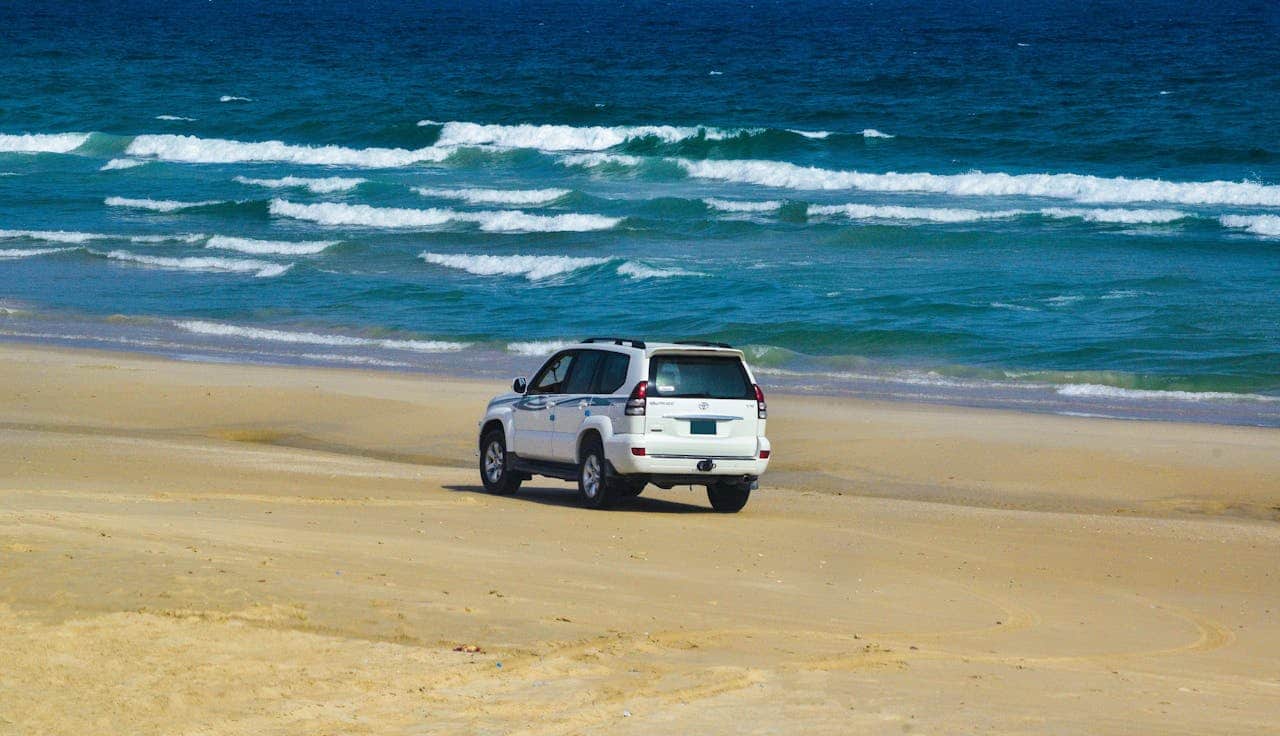
The roads to the northern coast are another matter. Reaching Fokos, Mersini, or Agios Sostis means leaving the asphalt for several kilometers of dirt and gravel. These tracks are passable in a standard small car driven carefully, but a clipped underside or a punctured tire is the most common rental damage on the island. Take it slowly and confirm before you go that your insurance covers undercarriage and tires — not all policies do.
Parking is the daily challenge. Mykonos Town itself is closed to non-residents; park at the paid lots at Fabrika or near the New Port and walk in. At the popular beaches, paid lots fill by mid-morning in season. The simplest rule: arrive early or arrive late.
The Meltemi — the strong summer north wind — affects driving on exposed coastal sections. Doors fly open. Light hatchbacks feel skittish on ridge roads. It is not dangerous, but it is real, and worth knowing.
Where the Car Earns Its Keep
A few places on Mykonos justify the rental on their own.
Ano Mera — the island’s only real inland village, with a working monastery (Panagia Tourliani) and tavernas serving food that costs half what it does in Mykonos Town. Fifteen minutes by car, impossible to reach conveniently by bus.
Armenistis Lighthouse — the northwestern tip of the island, with sunset views over Tinos. Bus does not go there.
Fokos and Mersini — the empty northern beaches, no sunbeds, no bars, just sea and silence. A car is the only way in.
Kapari Beach — a small bay near Agios Ioannis with a clear view of Delos. Manageable on foot from the parking area above.
Delos — not reachable by car, but the boats leave from the Old Port, and having a car to drive there and back saves you the long walk.
A Closing Note
A car rental Mykonos no deposit booking is genuinely possible, but the phrase is shorthand for several different arrangements, not a single product. The honest version — full insurance included, zero excess, no hold on your card — exists and is worth seeking. The dishonest version — no deposit at pickup, but a high excess and a thin policy waiting to bite if something goes wrong — also exists, and is the reason to read the contract before signing.
Mykonos rewards the traveler who looks beyond the obvious. The right car, booked on the right terms, is the simplest way to find that reward.