
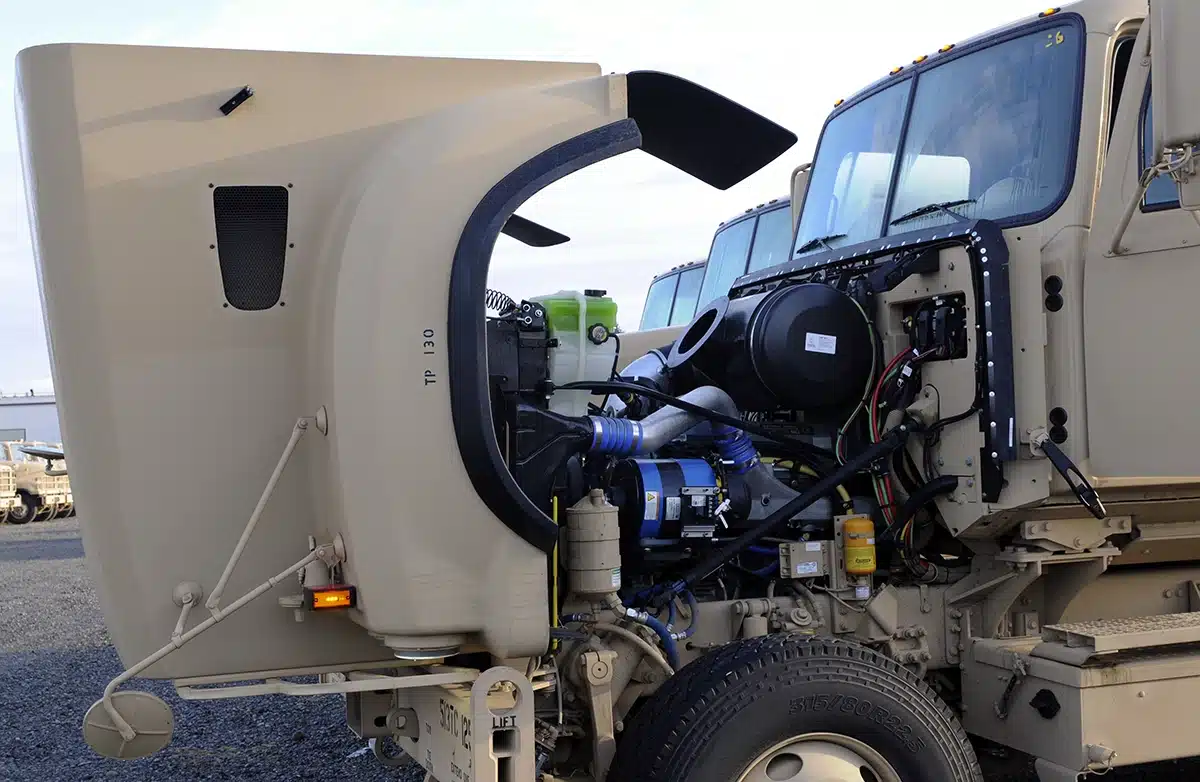
Any discussion around diesel emissions will often come around to someone bringing up the fact there are U.S. Military diesel engines deleted from the factory. This the commenter will point out is due to reliability.
Obviously, the commenter will state the U.S. Government itself knows the emissions equipment is unreliable.
This isn’t the whole story and is a half-baked truth at best.
U.S. Military diesel engines deleted from factory
This topic has come up once again with the news of the new EPA Administrator Lee Zeldin stating he is directing the agency to look into emissions rules to roll back mandates that harm businesses while maintaining the goals of the EPA to preserve clean air and public health.
Many people took his comments to mean the EPA was going to roll back emissions to the point where diesel emissions equipment would no longer be required to be installed on new trucks.
They pointed out this is already the case with the U.S. Military diesel engines that have been spotted without the equipment. This equipment includes the diesel particulate filter (DPF), exhaust gas recirculation (EGR) valve, diesel oxidation catalyst (DOC) and diesel exhaust fluid (DOC).
One TikTok video, embedded below, clearly showed a U.S. Air Force truck without the equipment which caused a further uproar online with outlets like Road and Track covering it as well.
However, nobody asked why this truck didn’t have it. It was just assumed all U.S. Military vehicles don’t come with emission equipment in the comments section of that video and others online on the same topic.
It’s about the fuel
Here is the truth and where it gets a little tricky.
First, diesel emissions equipment works with, and this is key, ultra-low sulfur diesel fuel. It is commonly referred to as ULSD. This fuel was created in 2006 by the EPA to work with the emissions equipment being developed around the same time. The fuel helps reduce pollutants in the air that can cause respiratory issues (asthma) and lung cancer.
During this time, the U.S. Military approached the EPA for a waiver to exempt tactical vehicles from emissions rules.
What does this mean? Tactical vehicles are those that are used in combat and deployed globally.
This makes a big difference. Why? Globally, ULSD isn’t widely available. If you use any other type of diesel fuel, or any other fuel regardless, you will plug up the DPF and cause the engine to be inoperable.
For the military, they need vehicles to run on whatever fuel they have available whether that be jet fuel, gasoline or diesel. There are even military vehicle engines designed to run on both diesel and gasoline fuel.
Some U.S. Military diesel engines do come with emissions equipment installed
If the tactical vehicles don’t have emissions equipment, wouldn’t it make sense that all U.S. Military vehicles don’t have the equipment? Why make exemptions?
I reached out to the U.S. Army to clarify where they stand on this question since they have a large amount of tactical equipment.
“The Army’s non-tactical diesel vehicles have emissions-control systems as equipped by the original equipment manufacturer,” said Captain Victoria Goldfedib, Army spokesperson. “In accordance with Section 118 of the Clean Air Act, the Army’s non-tactical vehicles meet federal, state and local emissions requirements established for the areas in which they are garaged or primarily operated.”
The truck in the video is from the U.S. Air Force and it makes sense they would follow the same rules and regulations the U.S. Army does for emissions requirements as well.
Our take
As usual, there’s more to the story when you spot a viral TikTok video and from uniformed commenters. The simple truth is it really just comes down to the availability of USLD. It has nothing to do with reliability. Sorry to disappoint those conspiracy theorists.






10 replies
Loading new replies...
Administrator
Administrator
Well-known member
Well-known member
Moderator
Administrator
Well-known member
Moderator
Well-known member
Moderator
Well-known member
Join the full discussion at the Forum Pickuptrucktalk →