
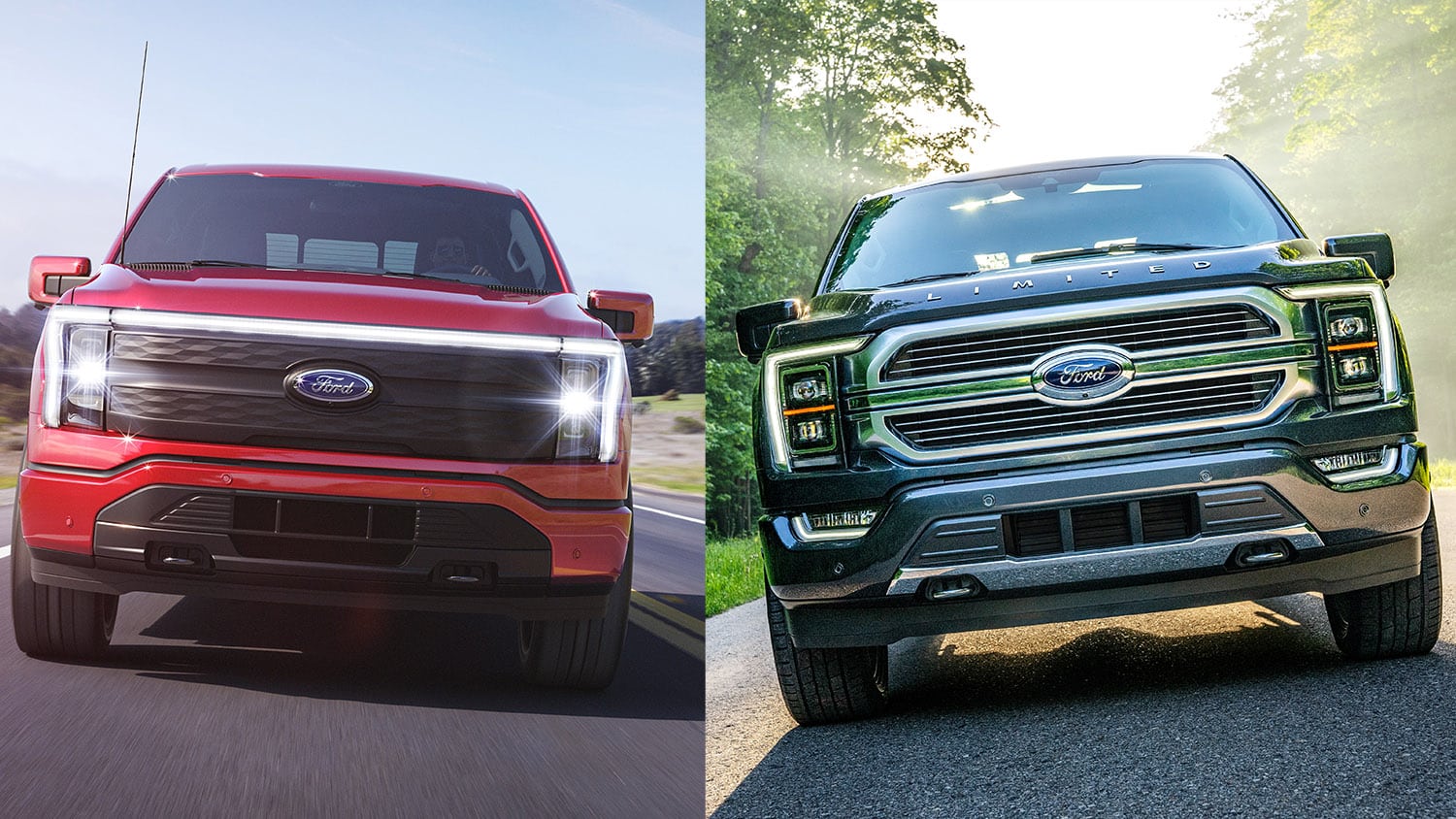
Because we love a good rabbit hole here at Pickup Truck + SUV Talk, Publisher Tim Esterdahl’s recent treatise on why electric trucks will have difficulty gaining mass adoption sent us on a deep dive of looking at gas vs. electric trucks.
[Related content: Electric trucks, SUVs with the most accurate range]
Specifically, Esterdahl said electric trucks “cost more.” While he’s referring to time costs as well as financial expenditures, we figured we should really dig into the actual expenses associated with gas vs. electric trucks and see where the chips fall.
Since the Ford F-150 is the only full-size truck to have both, that’s the truck we’re using for our rabbit hole exploration. Because vehicle prices keep climbing (in fact, Ford just raised the price of the base Lightning by $7k), the new Inflation Reduction Act confuses EV tax credits, and it’s a given that the EV will cost more than the gasoline model, we’re skipping the up-front cost-to-buy analysis and jumping right into “fuel” and maintenance costs.
We are using Nebraska as our “home base” since that’s more middle American than someplace like, say, Chicago. One other assumption we’re using: That most Americans are driving about 15,000 miles per year.
So, grab your mad hat and get ready to jump.
“Fuel” costs of gas vs. electric trucks
For our purposes, we’re looking at daily driving – not road trips or towing. So, this means your regular trips to the gas station and overnight charging.
In Nebraska, at the time of writing this article, the current cost of gas is $3.67 per gallon. Looking at EPA fuel economy numbers, the F-150 with the 3.3-liter engine averages 20 MPG and with the 2.7-liter engine averages 21 MPG. Therefore, the former will glug through 750 gallons of gas in a year, and the latter will eat up 714.29 gallons. So, annual cost will be between $2,752.50 and $2,621.44, depending on the model.
For the electric number, after consulting some EV experts I settled on getting 2 miles per kWh. Using the 15k miles number, that means an average consumer would use about 7,500 kWh per year. The current cost of at-home charging in Nebraska is $0.11 per kWh, so the annual cost to charge would be $820.
That’s an annual difference of $1,932.50 for the 2.7-liter XLT and $1,801.44 for the 3.3-liter XLT.
Maintenance costs
This is where things get interesting. We pulled the maintenance schedules from the owners’ manuals of both the Lightning and regular F-150, and to keep things equal, we went to a Nebraska Ford dealer and asked for associated costs. But even without looking at the prices, it’s easy to see the Lightning will cost less to maintain because it requires less regular maintenance overall. Specifically, there are 30k, 60k, 100k and 150k mileage maintenance items for the gas F-150 that just aren’t needed on the Lightning. So, over 10 years, you’re looking at $1,352 in scheduled maintenance for the Lightning versus $4,188 for the gas F-150.
Ford F-150 XLT Lightning Ford F-150 XLT
Cost to "fuel up" per year 820 $2,752.50/$2,621.44
Twice yearly maintenance X $50 Package Deal
Oil change X
Change the engine oil and filter X
Rotate tires X
Perform multi-point inspection X
Ispect transmission fluid X
Inspect brake pads X
Inspect engine coolant system X
Inspect exhaust system X
Inspect the front axle & U-joints X
Inspect half-shaft boots X
Inspect steering linkage X
Inspect wheels X
Annual Maintenance $39 Package Deal X
Rotate tires X
Multi-point inspection X
Inspect brake pads X
Inspect cooling system X
Inspect halfshaft boots X
Inspect steering linkage X
Inspect wheels X
Every 3 Years (45k)
Change brake fluid 149 149
Every 20k miles
Replace the cabin air filter 45 45
At 30k miles
Replace the engine air filter X 25
Replace the engine-mounted & frame mounted fuel filters X 150
At 60k miles
Replace spark plugs X 250
Inspect accessory drive belts X Free
At 100k miles
Replace accessory drive belts X 50
Replace spark plugs X 250
Inspect accessory drive belts X Free
At 150k miles
Change automatic transmission fluid & filter X 228
Change front & rear axel fluid X 165
Change the transfer case fluid X 73
Replace the accessory drive belts X 285
At 10 years
Change transmission fluid 200 X
At 200k miles
Change battery the coolant 200 X
Change the engine coolant X 185
Time costs
This is a tricky one because time is a very subjective cost. Some people would rather spend time than money, and others think the extra expenditures associated with gas vehicles are worth it. In his article, he pointed to the fact you’d have to spend 30 to 60 minutes to charge at a public station. But assuming people who buy an electric truck will also fork out the cash for an at-home charging station, the amount of time you’d need a public charger is minimal, whereas, if you own a gas truck, you’ll likely spend 10 minutes a week (520 minutes a year) at a gas station fueling up.
That’s about 9 hours a year you’ll spend at a gas station.
According to ZipRecruiter, the average salary of a person in Nebraska is $66,401 per year, which breaks down to $31.92 per hour (or a depressing $0.532 per minute). So, if time is money, that’s about $287.28 per year.
Using the same hourly rate, let’s now factor in the cost of getting maintenance done. Let’s start with oil changes. According to Jiffy Lube, that’s a 20- to 45-minute job. So, we’ll split the difference and say it’ll take 32 minutes twice a year. That’s another $34.05 per year.
Thus, in a year, you’ll spend $321.33 in fuel-up and maintenance time on a gas model verses, maybe, $17.02 for the annual maintenance of the Lightning.
But, that’s not accounting all the scheduled maintenance you’ll have over a 10-year period with the gasoline model you won’t have with the electric version, namely the 30k, 60k, 100k and 150k services. Let’s say, each check-up lasts an hour and a half (insert hysterically laughing emoji); that’s 30 hours* you’ll spend throughout 10 years waiting on maintenance to be complete, equaling an additional $957.60. So, for 10 years of time fueling up and waiting on maintenance, you’re looking at $4,170.90.
For the EV, assuming 100% at-home charging, you’re looking at 21.5 hours for all maintenance over 10 years and time spent worth $686.28.
The cost of a road trip
For giggles, let’s say you do decide to take one 1,000-mile road trip a year, that’s about the distance from Indianapolis, Indiana, to Orlando, Florida. For the entire trip, total distance will be about 2,000 miles.
For the Lightning, assuming you’ll get up to 80% charge in 44 minutes, you’re looking at a total of 11 stops with the standard-range battery and eight with the long-range battery. Using the Nebraska hourly wage again, that’s $257.49 and $186.26, respectively, just for your time.
Going back to the 2 miles per kWh we referenced above, you’ll use about 1,000 kWh for this trip, and with places like Electrify America charging $0.43 per kWh, that means you’ll pay $430 for “fuel.” So, the entire trip will cost you between $687.49 and $616.20, depending on your battery.
OK, now to the gas F-150. Using the EPA estimates again, you’ll get 483 or 460 miles per tank, with a 23-gallon tank. So, to be safe, you’ll probably stop five times to fill up. At 10 minutes a pop, that’s about $26.60 for your time. You’ll use about 100 gallons of gas for the 3.3-liter engine and 95 gallons for the 2.7-liter engine. Using the national average of $3.90 for gas this time, you’ll spend between $390 and $370.50 for fuel for the trip. So, the entire trip will cost you between $416.60 and $397.10, depending on your engine.
For a road trip, that’s more than $200 less for the gas model per year.
Adding up the numbers
Now that we’ve thrown a lot of numbers at you, your eyes are probably blurring a bit. Ours are. So, let’s break it down and do some math.
First let’s start with the time cost because that seems to be a pain point for a lot of people. The only time you lose time when owning an EV is when you’re going to be taking a road trip. For people who have two vehicles, one of which is a gas model, this becomes a non-issue. But if you’re going to take your EV to Florida, the cost of “fuel” will be similar between EV charging and pumping gas, but it’ll take an extra 6 to 8 hours for charging time, which we’d say amounts to about $200. Only you can decide if that’s a cost you’re willing to pay.
In terms of maintenance, the EV is the hands-down cost winner because you have annual maintenance, 20K, 3-year and 10-year services. That’s it. So, over 10 years, you’ll pay $2,836 more in maintenance for the gas model.
Fuel costs, however, are going to be the humdinger because you’re looking at just less than $30k over 10 years for the gas model, and just more than $8k for the EV.
In the table below, we’ve looked at both fuel and maintenance costs for 1, 2, 3, 5 and 10 years, comparing the Lightning to both the 3.3-liter and 2.7-liter engined F-150s. The last two columns show the cost differences per year of the gas vs. electric trucks. In the end after 10 years, taking time out of the equation, the gasoline trucks will cost $19,434.50 – $20,745 more to “fuel up” and maintain than the electric Lightning.
Lightning F-150 w/ 3.3L F-150 w/ 2.7L Lightning v 3.3L Lightning v 2.7L
1 year $859.00 $2,852.50 $2,721.44 $1,993.50 $1,862.44
2 year $1,763.00 $5,925.00 $5,442.88 $4,162.00 $3,679.88
3 year $2,771.00 $9,176.50 $8,783.32 $6,405.50 $6,012.32
5 year $4,579.00 $14,971.50 $14,316.20 $10,392.50 $9,737.20
10 year $9,552.00 $30,297.00 $28,986.40 $20,745.00 $19,434.40
The bottom line on the cost of gas vs. electric trucks
There is so much to take into consideration when you’re looking at costs associated with owning an EV – and we’ve probably missed something. But this gives you the general gist. While time spent charging on a road trip is a justifiable concern, if you look at the overall life of the vehicle, the actual cost of ownership is a lot more for the gas model.
So, do you want to spend a little extra up front and save time and money in the long run with maintenance and fueling? Or do you enjoy your weekly trip to the gas station and all the extra time and money you’ll spend on maintenance, just so you can keep your extra cash in the bank right now?
Seriously, we’d love to know your thoughts in the comments below.
*Editor’s note: We got to 30 hours by looking at how many times you’d need each service done in a 10 year period. So, a 3-year service would be done 3 times, multiplied by an hour and a half equals a total of 4.5 hours – just for that service. We included 20k, 30k, 60k, 100k and 150k mile services and tallied the total.
Related posts:
- What’s stopping electric trucks from mainstream adoption?
- Future not so bright for electric trucks?
- Do electric trucks need to tow? Rivian R1T trip raises towing questions








4 comments
Bruce
Don’t forget many states charge an “alternative fuel tax” to offset the tax included in gasoline prices. Let’s say $250.00 per year on average?
Anon Ymous
This analysis is missing the most expensive aspect of the Lightning: the battery pack is only warrantied for 100,000 miles and then costs $30,000 to replace. Will the battery be completely useless at 100,000 miles? Maybe, maybe not. The warranty period is 100,000 miles for a reason. At the very least, buyers should expect the battery capacity to diminish 2 – 3%/year x 8 year warranty period = 16 – 24%. Even if the battery lasts 150,000 or 200,000 miles, the extra $30,000 replacement cost makes the Lightning way more expensive to maintain than the comparable gasoline model. And don’t forget to add thousands of more dollars to buy and install a level 2 charger at home. The whole “electric is cheaper” argument is nonsense.
5ohbrad
I wouldn’t say it’s nonsense. I had a 2016 F150 with the 2.7 Ecoboost and the transmission failed at 67k miles- just out of warranty. The replacement cost quoted by the local dealer was $7500 and being deprived of the vehicle for months. For my 2022 Lightning I spent $400 on a charger and $1500 for an Electrician to wire it in along with a generator back feed. My normal use does not require me to ever use public chargers. The occasional road trip inconvenience (twice to Oklahoma from Texas) is a small concession to make for not having to fill up every few days or worry about performing oil changes. Even towing my boat to and from the local lake isn’t a problem. Is it right for everyone? No, but if you live in a home, drive less than 150 miles a day and don’t routinely tow for most of those miles, the Lightning is a far better vehicle than a gas F150, Coyote or Ecoboost. The performance, ride quality, frunk utility, maintenance and fuel savings are phenomenal. But if you are constantly driving cross country, live in a colder climate, pull trailers daily – gas is still the way to go.
texmln
Now put a value on these:
1) Being forced by the government to buy something you don’t want.
2) Being taxed.so the government can take your earnings and literally hand out cash to other people so they can buy something they want at a lower cost