
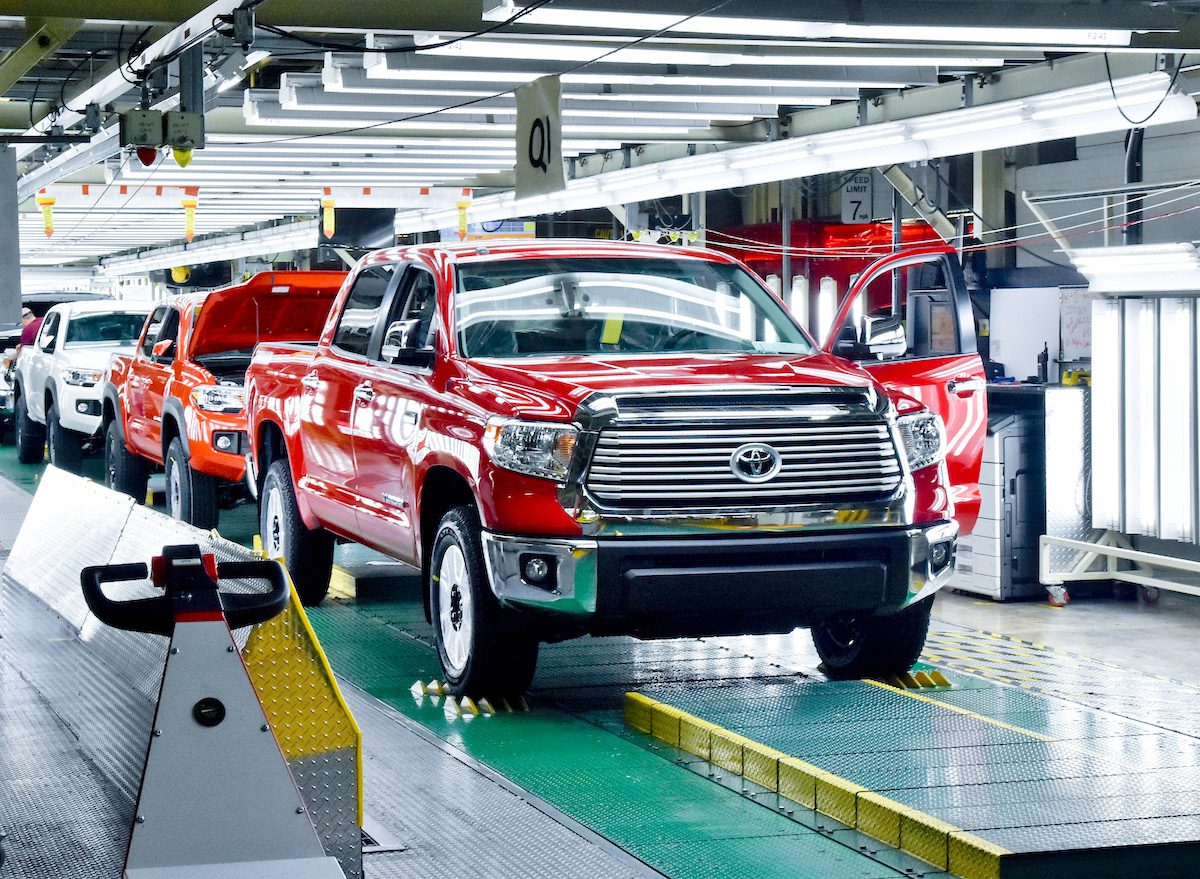
Rolling off the line at Toyota Motor Manufacturing of Texas, the last Toyota Tundra powered by a 5.7-liter V-8 engine was assembled, inspected and ready for transport today. There is now no turning back, and the age of small-displacement turbocharged engines is here for the full-size truck.
Toyota manufacturing team members made the announcement at a media briefing I attended prior to a quick tour of the new frame assembly at the plant. The announcement was made without fanfare and felt like an afterthought. Like, oh yeah, we just built the last V-8 Tundra today.
No pictures, no ribbon, no press release. Just like that, the Tundra V-8 is dead.
The slow death of the Toyota 5.7-liter engine
For years, the V-8 engine has faced a host of challenges to improve both fuel efficiency and to reduce emissions as air quality standards and consumer demands have changed. Toyota, like all automakers, has made pledges to reduce its carbon footprint. The fact is, the V-8 engine just doesn’t fit into those plans.
Toyota has slowly been working on eliminating the V-8 engine for years. For example, the smaller 4.7-liter V-8 option for the Tundra was killed a few years ago. Then the U.S. version of the Land Cruiser was eliminated from the market clearing that V-8 engine choice.
Lexus has also played a role in the V-8’s demise, killing the V-8 in many of its cars, instead offering a turbocharged option as well as restricting the 5.0-liter V-8 option for its more performance-oriented sedans.
Frankly, Toyota has declared war on the idea you need a V-8 engine.
The staple for years
Through the evolution of trucks over the years, the V-8 engine has gone from a staple to a compromise engine.
It used to be a regular-cab, long-bed, V-8 truck was the best tool available. Sure, you used some gas, but you got the larger displacement engine for better towing, hauling and the thunder under the hood.
Ford started the revolution by offering the small displacement EcoBoost engine lineup with a turbocharged small-displacement engine providing fuel economy as well as towing power through the turbos.
Toyota fired back with its rather infamous statement of “no replacement for displacement,” only to find it had to capitulate to the reality. A turbocharged V-6 engine just, well, performs better in most cases for truck buyers and it meets the ever tightening emissions standards.
Turbos are less reliable!
One of the passionate arguments you’ll hear from V-8 fans is the simplicity of the engine design along with the old thought of turbos being less reliable means a turbo V-6, including the Tundra’s new V-6 engine, is simply an awful idea.
This argument, fought over any number of social media sites, forums and barstool conversations has been the accepted truth among truck enthusiasts. Sadly for their argument, it just doesn’t work.
Diesel engines, including those found in semi trucks, have long used turbos to improve performance for both towing and fuel economy. Those turbos have been reliable. It is rather odd then that the turbos for a half-ton are somehow different from the turbos used in different applications.
Toyota truck engineers, likely reluctantly, saw the writing on the wall.
The bottom line on the Toyota 5.7-liter engine
The fact is the trucks have evolved from a true work tool into a multi-faceted swiss army knife, if you follow the analogy. They can spend a day on the ranch, get cleaned up and take the family to town. This means they need a sedan-like ride and better fuel economy while not sacrificing the towing and hauling ability. Quite simply, the V-8 engine is the wrong engine for that job.
Sadly, this is true. Truck enthusiasts, like Toyota engineers, know this to be true. And I know this as well — as hard as I’ve argued otherwise. It’s just the sign of the times.
While the lastTundra V-8 rolling off the line will be a side note on Wikipedia someday, I can’t help but notice the lack of fanfare. Myself, I’ll be pouring out a glass of whiskey on the end of an era. The future is now, and it isn’t a V-8.
That was a hard sentence to write.
Related posts:








4 comments
Anonymous
Last year got my 2021 Tundra with 5.7l engine. Myself never buy a electric vehicle or any gas engine supercharge.Will not last like normal aspiration gas engines. Diesel different story on turbocharged.
Richard
I work on semi trucks turbos go out more than people think variable vane actuators seize seals go out pump oil intake bearings go out list goes on Cummins cat don’t matter
Elzippo
I’ll keep my V8 until they pry it form my cold dead hands
No
Shut up