Pickup owners tend to think about transport pricing the same way they think about towing capacity. If the truck runs, rolls, and starts, a hauler should be able to move it. That logic works for a stock midsize pickup or a half-ton truck with factory tires. It breaks down once the truck has a lift, oversized rubber, a long bed, a camper shell, a rack system, or a bed full of bolted-on equipment.
Transport companies move pickups every day. The problem is that a modified pickup changes the physical job the carrier has to perform. It can take up more trailer space, add more weight, create height clearance problems, require a different deck position, or force the dispatcher to find a carrier with the right equipment.
That is where the quote changes. A carrier is pricing the space, risk, route fit, loading difficulty, fuel, time, and legal limits attached to that specific truck.
A Modified Pickup Is Bigger Than Its Model Name
The phrase “I need to ship an F-250” does not tell a dispatcher enough. A regular-cab work truck, a crew-cab diesel, and a lifted show truck with 37-inch tires all fit under the same basic model family. They do not fit the same way on a car hauler.
Factory pickups are already large compared with sedans and crossovers. A late-model full-size crew cab can stretch past 230 inches long, and heavy-duty pickups can be taller, heavier, and harder to position than a typical passenger vehicle. Add a suspension lift, wider wheels, a headache rack, a bed cap, a toolbox, or a fifth-wheel hitch, and the carrier has a different load than the one suggested by the badge on the fender.
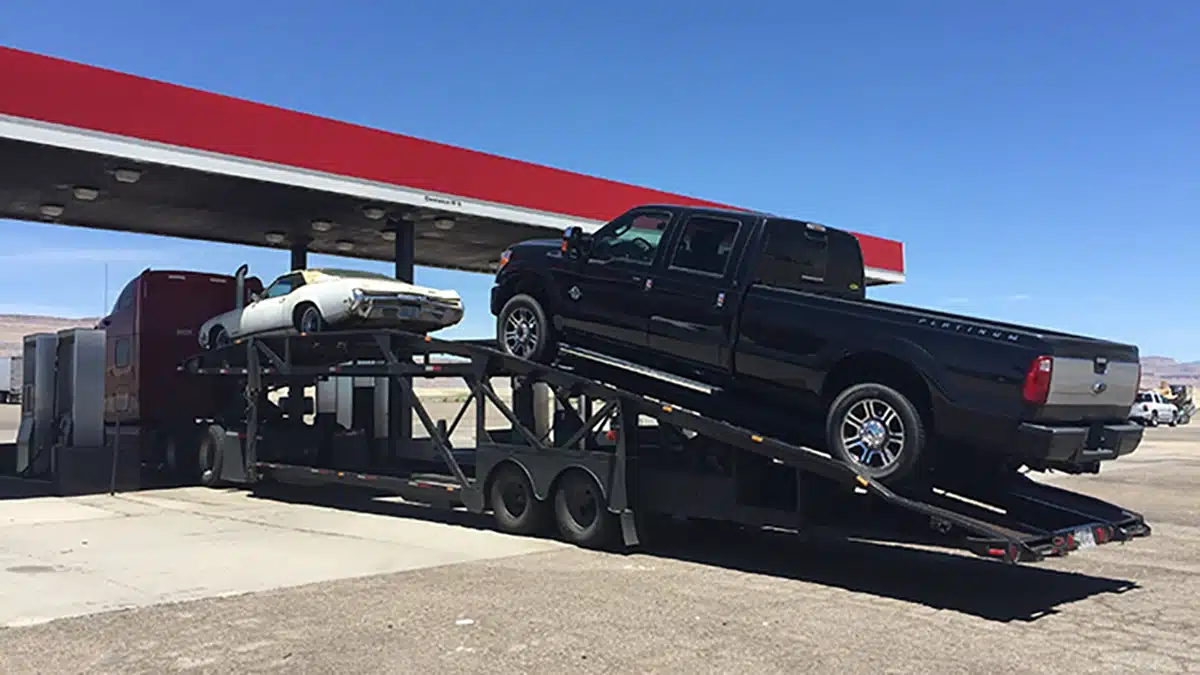
Height is usually the first problem. Open car carriers often stack vehicles on upper and lower decks. A lifted truck may be too tall for the upper deck once the driver accounts for bridges, tree limbs, loading angles, and other vehicles already on the trailer. If the truck can only ride on the lower deck, it may displace a larger portion of the load plan than a stock pickup would.
Length creates a second problem. A long-bed crew cab may occupy trailer space that could otherwise fit a smaller vehicle behind it. Wider tires and offset wheels can also complicate positioning because the driver has to leave enough space for doors, straps, fenders, ramps, and adjacent vehicles.
Weight matters too. Diesel engines, larger wheels, bumpers, winches, skid plates, auxiliary fuel tanks, and bed-mounted equipment can add hundreds of pounds. That added weight can change how the driver balances the trailer. A carrier moving several vehicles has to think about total trailer weight and axle distribution, not only whether one truck can physically climb the ramps.
The Carrier Has to Build a Load Around the Truck
A transport truck is not a private flatbed reserved for one vehicle unless the customer pays for that arrangement. Most open auto transport loads are built around several vehicles moving along a route. Each vehicle needs a pickup window, a delivery location, a deck position, and a price that makes the route worth accepting.
A modified pickup narrows the carrier pool. Some haulers will not accept lifted trucks. Some will accept them only if the height is disclosed upfront. Others may need exact measurements before they decide whether the truck can ride on their trailer. A dispatcher who has accurate details can look for the right carrier. A dispatcher who gets vague details may post a load that drivers ignore.
That is why the cheapest quote often becomes the slowest quote. If the price assumes a stock truck but the vehicle turns out to be taller, heavier, or harder to load, carriers can pass on it. The order may sit until the broker raises the offer or finds a compatible route.
Route density changes the picture. A modified Silverado moving from Dallas to Phoenix will usually have more carrier options than a lifted diesel dually being picked up outside a rural mountain town. The second shipment may require empty miles, extra coordination, and a driver willing to commit trailer space to a truck that cannot be placed anywhere on the rig.
On the pricing side, distance, vehicle type, transport method, timing, and location all shape the final cost, according to Sherpa Auto Transport. A modified pickup touches several of those variables at once, which is why two trucks traveling the same distance can receive different quotes.
Securement Is a Real Constraint, Not a Detail
Once a pickup is on the trailer, the job changes from booking to securement. The truck has to stay put through braking, turns, ramps, rough pavement, and highway-speed vibration. That is not a casual best practice. It is a regulated safety requirement.
The Federal Motor Carrier Safety Administration says cargo securement rules are intended to prevent cargo from shifting, falling, or moving on commercial vehicles. FMCSA’s rules require securement systems to withstand forces in forward, rearward, and lateral directions, including 0.8 g of forward deceleration and 0.5 g of rearward or lateral acceleration. Those numbers matter when the cargo is a 6,000-pound truck with oversized tires sitting high above the trailer deck.
Federal rules for automobiles, light trucks, and vans add more specific requirements. Under 49 CFR 393.128, vehicles at or under 10,000 pounds must be restrained at the front and rear to prevent lateral, forward, rearward, and vertical movement. The rule also recognizes wheel-based tiedowns, which is how many carriers secure passenger vehicles and light trucks.
Modified pickups can complicate that normal securement process. Oversized tires may not work cleanly with standard wheel straps. Very wide tires can change strap angle. Low-pressure off-road tires, beadlock-style wheels, sharp suspension components, or aftermarket bumpers may leave the driver with fewer clean attachment choices. The driver needs the right gear and enough time to secure the truck correctly.
The 10,000-pound line also matters for some extreme builds. Most personal pickups stay under it, but a heavily equipped diesel truck with tools, accessories, auxiliary tanks, or commercial equipment can move closer to the threshold than the owner realizes. The customer needs to tell the carrier what the truck actually weighs and what has been added to it.
Modifications Can Change the Loading Risk
The loading process is where many hidden costs show up. A stock truck usually climbs a carrier’s ramps without much drama. A modified pickup may have a different breakover angle, clearance, stance, or front bumper setup.
Lifted trucks seem easier because they have more ground clearance. Sometimes they are. The height that helps on a trail can become a problem on a multi-car trailer, especially if the truck has to clear the upper deck structure or fit below another vehicle. A long wheelbase can also make the ramp transition awkward, particularly with low-hanging steps, exhaust tips, mud flaps, or custom hitch equipment.
Lowered pickups create the opposite problem. Air dams, splitters, side skirts, and custom exhaust can scrape on standard ramps. A truck that looks like an easy half-ton load may need extended ramps, extra boards, or a carrier comfortable with low-clearance vehicles. That extra care takes time, and time affects whether a driver wants the load at the posted rate.
Loose accessories create another risk. A bed rack, traction boards, recovery gear, toolboxes, spare tires, or cargo in the bed may be normal on the owner’s driveway. On a transport trailer, loose or poorly secured items become liability. FMCSA’s general securement guidance says cargo must be immobilized or secured with adequate structures, tiedowns, blocking, or related systems. A carrier moving a pickup does not automatically agree to transport everything attached to it or sitting inside it.
This is why many carriers ask owners to remove loose items, disclose aftermarket parts, and keep the fuel level low. Those requests are not arbitrary. They reduce weight, limit claims disputes, and make the driver’s securement job cleaner.
Fuel and Equipment Costs Hit Heavy Trucks First
A modified pickup also costs more to move because the carrier’s own operating costs are high. The transport rig runs on diesel, burns more fuel when loaded heavily, and loses money when a route is priced too low for the space and weight involved.
The U.S. Energy Information Administration reported a national average on-highway diesel price of $5.640 per gallon for May 4, 2026. The same EIA table showed California at $7.360 per gallon and the West Coast average at $6.631. A hauler running a heavy load through high-cost fuel regions cannot ignore those numbers when deciding whether to accept a pickup.
Equipment availability adds another layer. Some pickups fit best on a wedge trailer, some on a standard open carrier, and some on enclosed transport if the truck is valuable, freshly built, or headed to a show. Enclosed transport costs more because the equipment is less common, carries fewer vehicles, and provides more protection. For a custom truck with expensive paint, rare parts, or a show deadline, that higher price may be easier to justify than the risk of open transport.
Accurate Details Beat a Low Quote
Owners can prevent most pricing surprises by giving the carrier real measurements before the quote is finalized. The basics are simple: year, make, model, cab, bed length, two-wheel drive or four-wheel drive, running condition, and pickup and delivery ZIP codes. Modified trucks need more.
The carrier should know the truck’s approximate height, tire size, lift or lowering details, curb weight if available, and whether it has a camper shell, rack, winch bumper, dually rear axle, toolboxes, spare tire carrier, fifth-wheel hitch, or anything mounted in the bed. Photos from each side can answer questions a written description misses.
Owners should also be honest about access at both ends. A rural driveway, tight neighborhood, low trees, steep grade, gated community, or narrow street can force the driver to meet at a truck stop, shopping center, auction lot, or wide industrial road. That is still normal door-to-door transport in practice. The driver gets as close as the equipment can safely go.
Flexibility helps more than most owners expect. A firm pickup date gives the dispatcher fewer routes to work with. A window of several days gives the carrier a better chance to place the truck on a route that already makes sense.
The Real Cost Is the Trailer Space
Shipping a modified pickup costs more because the truck asks more from the transport system. It may need a specific deck position, a more careful loading process, stronger planning around height and weight, or a carrier willing to give up space that could have gone to easier vehicles.
A carrier can plan for a lifted diesel, a long-bed dually, a show truck, or a rack-equipped overland build when the details are clear before dispatch. Surprises are what turn a quote into a problem.
For pickup owners, the best move is simple: quote the truck that exists, not the truck that left the factory. The price may be higher than a stock vehicle quote, but it is far better than watching the right carrier drive away because the truck on the trailer does not match the truck in the order.