
Electric pickup trucks have fundamentally changed the automotive landscape in 2026. Vehicles like the GMC Sierra EV, Chevy Silverado EV, and Rivian R1T are engineering marvels designed for heavy-duty work and impressive hauling capabilities.
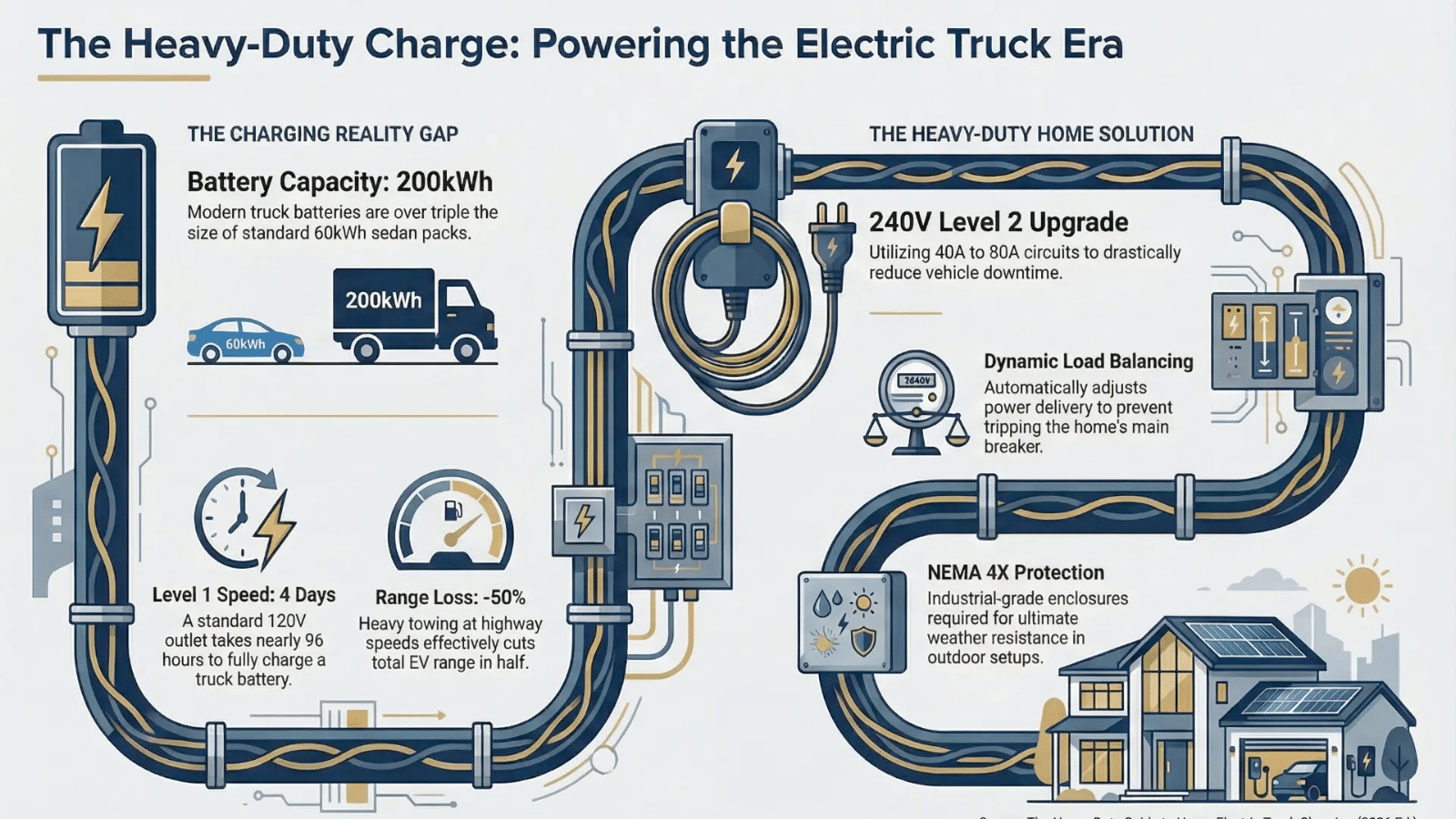
However, their massive physical size requires equally massive energy storage. While a standard commuter electric sedan might feature a 60kWh battery, modern electric trucks boast battery packs ranging from 130kWh to well over 200kWh.
This exponential increase in capacity means that traditional home charging methods are no longer sufficient. To keep these powerful utility vehicles operational, a complete overhaul of your home energy strategy is strictly required.
Level 1 vs. Level 2 Charging: Why Upgrading is Mandatory for Trucks
The Problem with Standard 120V Outlets
Many first-time EV owners assume they can rely on the standard Level 1 charger included with their vehicle. These base-level chargers plug into a standard 120V household outlet and deliver a slow trickle of electricity.
For a small sedan, overnight Level 1 charging might recover a daily commute’s worth of range. But for a truck equipped with a massive 130kWh battery, a Level 1 charger would take nearly four days to reach a full charge from zero.
This agonizingly slow charging speed is entirely impractical for truck owners. Relying on 120V outlets simply cannot sustain a vehicle used for daily towing, hauling, or long-distance driving.
Investing in a High-Power Level 2 Charger
When dealing with massive battery packs like those found in modern electric trucks, generic wall chargers often fall short in sustained power delivery and safety. For truck owners, upgrading the garage circuit and investing in BENY that offer dynamic load balancing and rigorous safety certifications is no longer optional—it is a necessity to prevent electrical panel overloads during 12-hour charging sessions.
A robust Level 2 charging station operates on a dedicated 240V circuit, similar to what is used for a heavy-duty electric oven. By pushing 40A, 48A, or even 80A of current, these stations dramatically reduce vehicle downtime.
When selecting a heavy-duty Level 2 charger, look for the following industrial-grade features:
- Dynamic Load Balancing (DLB): Automatically adjusts charging speeds to prevent tripping your home’s main breaker.
- Advanced Safety Protections: Built-in AFCI (Arc Fault Circuit Interrupter) and thermal monitoring.
- High NEMA Ratings: NEMA 4 or NEMA 4X enclosures for ultimate weather resistance during outdoor installations.
Real-World Range and Towing Impact on Charging Frequency
Electric trucks are built to work, but heavy loads severely impact their aerodynamic efficiency. Towing a large camper or a heavy equipment trailer drastically alters the vehicle’s rolling resistance and weight distribution.
In real-world conditions, towing at highway speeds can effectively cut your total EV range in half. We have documented this severe energy draw extensively in our recent EV truck towing tests, showcasing exactly how much extra power is required.
Because of this steep efficiency drop, truck owners must plug in much more frequently than the average EV driver. A high-capacity home charger ensures you can recover those depleted electrons overnight and be ready for another full day of hauling.
Solar Power Integration: Charging Your Truck Off-Grid
Powering a 200kWh battery exclusively from the grid can lead to skyrocketing monthly utility bills. To mitigate these costs, many homeowners are integrating Solar PV (Photovoltaic) systems directly with their home EV charging infrastructure.
This off-grid approach requires sophisticated electrical hardware, including high-efficiency Microinverters that convert solar DC power into usable AC power for your truck’s charger.
Safety is paramount when combining solar generation with high-draw EV charging. Ensuring your solar array features Rapid Shutdown capabilities and comprehensive fault protection guarantees a stable, secure energy flow.
The Future of EV Infrastructure for Heavy-Duty Vehicles
As automakers continue to engineer trucks with higher towing capacities and larger battery packs, the external infrastructure is racing to keep up. According to recent reports on the rapid expansion of EV infrastructure, federal and private investments are prioritizing heavy-duty charging corridors and advanced home energy storage systems to support this new era of electrified utility vehicles.
Beyond the home garage, public DC Fast Charging (DCFC) stations are actively upgrading to handle 350kW+ outputs. This push is specifically designed to accommodate the massive battery packs of electric pickups without causing massive delays at the pump.
Staying informed on these hardware advancements is crucial for long-term ownership satisfaction. For more insights on how these heavy-duty vehicles hold up over time, check out our coverage on general EV truck reliability and model news.
Key Takeaways
| Area | Key Takeaway | Impact/Data |
| Charging | Upgrade to Level 2 (240V) | Eliminates 4-day 120V charge times |
| Safety | Require Dynamic Load Balancing | Prevents electrical panel overloads |
| Usage | Factor heavy towing penalties | Cuts total EV range by 50% |
| Costs | Integrate Solar PV systems | Offsets 200kWh battery grid expenses |
| External | Monitor DCFC station upgrades | Leverages new 350kW+ fast charging |
Conclusion
Owning an electric pickup truck offers incredible performance, torque, and utility, but it fundamentally rewrites the rules of home energy management.
Before taking delivery of a heavy-duty EV, assess your home’s electrical panel and budget for a dedicated Level 2 charging installation.
By investing in commercial-grade chargers and preparing your circuits for potential solar integration, you guarantee your truck is always fully charged and ready to work.








