Heavy SUVs are everywhere right now — on freeways, in school parking lots, on desert highways doing 85. Families pick them for space, contractors use them to haul, and a lot of those drivers got their license in a sedan and never really learned how a 5,500-pound vehicle behaves when weather turns against them. This piece is about the actual mechanics: braking distance, center of gravity, tire load, and what happens when extreme conditions make those decisions for you.
When the Road Gets Slick: The Physics Nobody Talks About
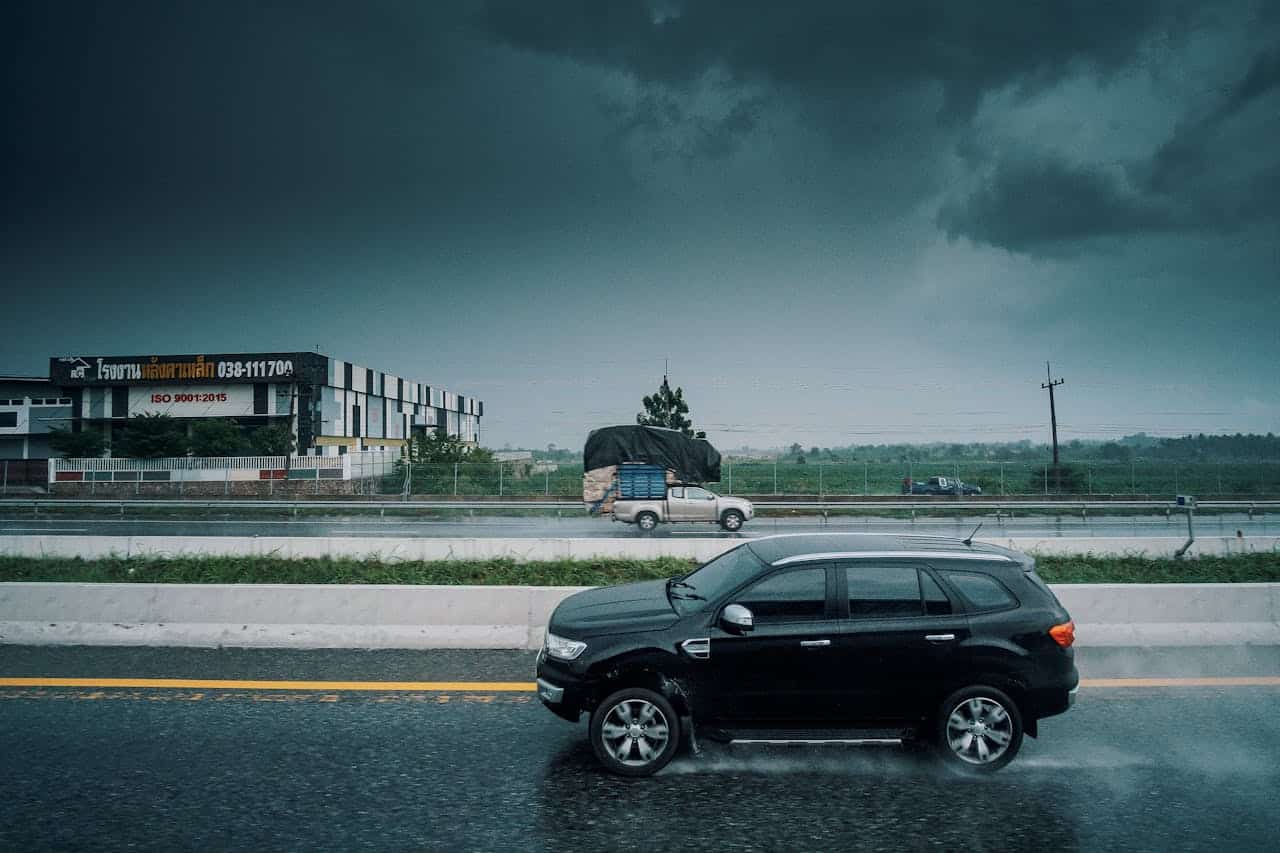
Large SUVs carry their center of gravity higher than almost any passenger car. Taller body, more height. Simple geometry. On a dry road at highway speed that’s manageable. Add rain, a crowned highway surface, and tires that haven’t been rotated in 18,000 miles — suddenly things get complicated.
Braking distance is the number that matters most, and the one most drivers ignore. A loaded Expedition at 60 mph needs roughly 130 to 150 feet to stop on dry pavement. Wet surface? That number climbs by 30 to 50 percent. Towing a boat trailer at 8,000 pounds — add another significant margin on top.
Roads along the I-10 corridor near Palm Springs are a good example. The desert gives drivers a false sense of security: wide lanes, clear skies, then half an inch of rain drops on asphalt that’s been baking all summer. The road goes almost as slick as black ice for the first twenty minutes. Drivers who’ve handled mountain snow sometimes fare better than locals in those moments, which says something about how habit shapes perception. When crashes involve multiple vehicles on that stretch, consulting a truck accident lawyer Palm Springs is often the next call — because these situations typically come down to exactly that gap between vehicle capability and driver expectation.
Traction Control and ABS: Useful, Not Magic
Most modern SUVs come standard with ABS, traction control, and electronic stability systems. Good. But treating those systems as a substitute for technique is where drivers get into trouble.
ABS prevents wheel lockup under hard braking. It doesn’t shorten your stopping distance on ice — on loose gravel or packed snow, it can actually increase it slightly. What it does is let you steer while braking. Valuable. Not magic.
Stability control (AdvanceTrac, StabiliTrak, VSC — different brand names, same concept) monitors yaw rate against steering input and intervenes when the vehicle starts rotating beyond what the wheel position would explain. Once a tall SUV has committed to a roll, though, the intervention window is extremely narrow. These systems buy time and reduce consequences from small errors. They don’t rewrite physics.
Desert Heat, Tire Pressure, and Blowouts
Driving through the Mojave in July is a stress test most tires weren’t designed to pass repeatedly. Pavement surface temperatures can exceed 160°F. Factory-spec pressure for a full-size SUV sits around 35–40 PSI. Heat builds pressure inside the tire — which sounds fine until age, tread wear, and load enter the equation.
A blowout on a heavy SUV is a different animal than one on a compact car. More weight, higher center of gravity, more momentum. The instinct to brake hard is wrong. That’s how rollovers start. Gradual deceleration, firm steering, keep it straight.
Check the DOT code on your sidewalls. The last four digits are the manufacturing week and year. Tires past six years old should be replaced regardless of tread depth — the rubber degrades internally before it shows on the surface. The tire industry has said this clearly for years. Dealer service departments rarely bring it up.
Four-Wheel Drive Doesn’t Brake
Worth repeating because it genuinely doesn’t stick.
4WD helps you accelerate on slippery surfaces. It does nothing for braking. A 6,000-pound SUV with 4WD engaged stops in exactly the same distance on ice as one in 2WD. Often, 4WD drivers go faster because they feel capable — and then find out that extra confidence counts for nothing when they actually need to stop.
The multi-vehicle pileup on I-90 in Washington state back in 2006 involved a disproportionate number of trucks and SUVs. Witnesses described drivers at or above speed limit in conditions that clearly called for a slowdown. That event is still referenced in driver training discussions, because it illustrated at scale exactly what happens when size and traction technology create false confidence.
Black ice deserves its own mention. It forms just below freezing, usually under overpasses or in shaded sections. No visual cue. If the temperature is between 28–33°F and vehicles ahead are losing control, treat every bridge deck and shaded stretch as black ice and reduce speed before you reach it.
High Winds and High-Profile Vehicles
A full-size SUV towing a travel trailer in a 40 mph crosswind is a genuinely hazardous situation. Aerodynamic cross-section matters — the taller and wider the profile, the more force the wind exerts. A loaded Suburban pulling a 30-foot trailer catches wind like a wall.
Trailer sway is the specific failure to understand. It starts when a gust hits the trailer, the trailer oscillates, and drivers who counter-steer aggressively tend to make it significantly worse. The right response: apply trailer brakes independently if the setup allows, reduce speed gradually, no sharp steering corrections. Some weight-distribution hitches include sway control built in. If you’re towing regularly through mountain or desert terrain, it’s worth having.
When Conditions Change Without Warning
Flash flooding on canyon roads. Sudden fog near coastal highways. Temperature drops of 15 degrees in under an hour on mountain passes. Extreme weather rarely sends advance notice.
The consistent advice from experienced long-haul drivers comes down to one thing: reduce speed before you need to, not after. A vehicle’s safety systems perform best when given more time to work. Know your actual towing capacity — off the door jamb, not from memory. Check tire pressure monthly, not when the dashboard light turns on. By then you’re already underinflated.
Heavy SUVs are capable, well-engineered vehicles. The question is whether the person driving one understands what happens when the road stops cooperating. Most of the time, the gap isn’t in the truck.