Back in 2023, 5,472 people died in traffic crashes involving large trucks across the United States. For pickup owners, the scariest part? Sixty-five percent of those fatalities were occupants of other vehicles.
Think about the math for a second. Your pickup weighs roughly 5,000 pounds. A fully loaded commercial semi tips the scales at 80,000 pounds. At highway speeds, the physics are devastating for the smaller vehicle. And with e-commerce booming and supply chains pushing more freight onto the roads every year, the number of semis sharing your lane isn’t going down anytime soon.
The danger is especially acute in corridors where port traffic meets interstate commerce. The Hampton Roads region, for example, saw a 75% spike in fatal truck crashes, resulting in 28 deaths in a single year.
But surviving the initial impact is only the beginning. In this guide, you’ll learn exactly how to secure the accident scene, navigate complex federal trucking regulations, and protect your financial well-being against aggressive insurance adjusters.
Securing the Scene and Gathering Evidence
Commercial crash scenes are chaotic, dangerous, and fast-moving. Right after impact, physical safety comes first. If your pickup is still drivable and it’s safe to move, pull onto the shoulder to avoid secondary collisions. If the truck is disabled in a traffic lane, flip on your hazards, check for injuries, and call 911 immediately. Tell the dispatcher a commercial vehicle is involved; that changes the emergency response level.
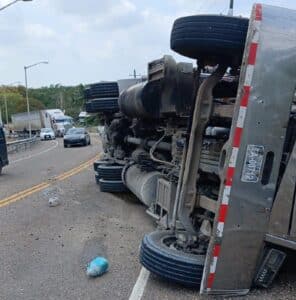
Recent Virginia wrecks show just how quickly these scenes spiral. In March 2026, a tractor-trailer crashed on I-95 in Richmond after swerving for an unknown reason and slamming into a Chevrolet pickup before going over an embankment. The result: a massive diesel spill and multiple lanes shut down.
That same spring, a milk truck crashed fatally on I-295 in Hanover County after hitting an occupied vehicle and running off the road into the trees. And a dump truck collision on I-664 in Newport News sent a driver to the hospital. In every case, highways shut down within minutes. Tow trucks and emergency crews clear the road fast, which means evidence disappears just as quickly.
So what should you do if you’re physically able to move around the scene? Grab your phone and document everything before the vehicles get towed:
- Photograph the DOT number. Capture the USDOT and MC numbers on the truck’s cab door. These link directly to the carrier’s federal safety record and inspection history.
- Document the carrier name and logo. Get clear shots of all company signage on both the tractor and the trailer. The cab might belong to an independent contractor, while a huge logistics corporation owns the trailer. Those are two completely different liable parties.
- Capture vehicle positioning from multiple angles. Photograph skid marks, debris fields, and the final resting positions. Wide-angle shots help accident reconstruction experts figure out speed, braking time, and the exact point of impact.
- Record witness information immediately. Get names and phone numbers from bystanders and other drivers before they leave. Police officers at a chaotic scene often don’t have time to interview everyone.
- Photograph the weather and road conditions. Rain-slicked asphalt, missing signs, faded lane markers, blinding sun glare; anything that could factor into the liability investigation.
The Police Report and Federal Trucking Regulations
Figuring out who’s at fault after a commercial wreck is far more complicated than a typical fender bender. When two passenger cars collide, liability usually falls on one at-fault driver. When a pickup collides with an 18-wheeler, the liability web expands fast. The truck driver, the trucking company, the third-party cargo loader, the maintenance provider, and even the vehicle manufacturer could all share financial responsibility.
The economic scale here is staggering. Crashes involving commercial motor vehicles cost an estimated $175.8 billion annually when adjusted for inflation. Virginia alone records over 5,570 commercial crashes per year, accounting for nearly 5% of all traffic collisions statewide.
Many of those collisions are entirely preventable. Drivers push past their legal hours of service. Maintenance crews skip brake inspections. Dispatchers demand unrealistic delivery windows. And plain old negligence plays a massive role; in Norfolk, speeding causes 21% of fatal crashes and severe injury collisions.
Identifying who actually owns the commercial vehicle is a key early step. While a vehicle owner search works fine for passenger cars, tracing commercial ownership requires digging through Federal Motor Carrier Safety Administration (FMCSA) registry records. You’ll also need data from the truck’s Electronic Logging Device (ELD) and its black box (known as the Electronic Control Module). These devices record speed, braking, and engine RPM in the seconds before a crash.
Here’s how the investigative process differs between a standard car wreck and a commercial truck collision:
| Accident Type | Liability Structure | Evidence Required | Insurance Limits |
|---|---|---|---|
| Standard passenger vehicle | Usually the at-fault driver | Police report, photos, witness statements | $25,000 to $100,000 personal limit |
| Commercial semi-truck | Driver, carrier, cargo loader, manufacturer | Federal logs, black box data, maintenance records, DOT compliance checks | $750,000 to $5+ million commercial policies |
When police arrive, they’ll generate an initial crash report. That document matters, but it’s often incomplete on the commercial side. The responding officer will note visible damage and driver statements, but they rarely download the truck’s black box on the side of the highway or audit the driver’s logbook on the spot. Crucial federal violations that directly caused the crash can easily go unrecorded in that first report.
Handling Aggressive Commercial Adjusters
Here’s something most pickup owners don’t expect: trucking companies and their insurers deploy specialized rapid response teams the moment a severe wreck hits their dispatch. These trained investigators, defense attorneys, and insurance adjusters sometimes arrive at the scene before the wreckage is even cleared. Or they’ll call victims within hours, sometimes while you’re still in the emergency room.
Their goal? Protect the company’s multi-million dollar policy. They use friendly, concerned tones to get you talking. They’re hoping for apologies, offhand comments, or admissions that you didn’t see the truck braking. Anything that helps minimize their liability and shrink the payout.
Don’t fall for it. Never provide a recorded statement, sign medical release forms, or accept an early settlement offer from a commercial carrier without talking to an attorney first. Those early offers are designed to cover only your ER bill. They won’t account for long-term rehab, lost future income, or permanent disabilities.
Fighting a commercial trucking insurer requires specific expertise in federal regulations, including hours-of-service laws, mandatory drug testing protocols, maintenance log compliance, and more. If you’ve been in a wreck in the Hampton Roads area, consulting an experienced Norfolk truck accident lawyer before speaking to any corporate adjuster is a smart move. A good choice would be Huffman & Huffman Brothers-in-Law, a family-owned firm with over 150 years of combined legal experience, which focuses specifically on these kinds of cases and has a strong record against predatory commercial insurers.
Safeguarding Your Highway Journeys
Surviving the physical impact of a commercial truck crash is only the first hurdle. The financial and legal aftermath can be just as punishing if you’re not prepared. The difference between being buried in bills and securing a fair recovery often comes down to how well you preserved evidence and how quickly you got ahead of the insurance company’s tactics.
So take some proactive steps now, before an emergency ever happens. Review your auto insurance policy today and make sure you understand your underinsured motorist coverage limits. Equip your pickup with a quality dashcam, so you always have an objective recording of your drive. Know your rights, stay alert around commercial traffic, and never let a carrier’s insurance team pressure you into giving up what you’re owed.