
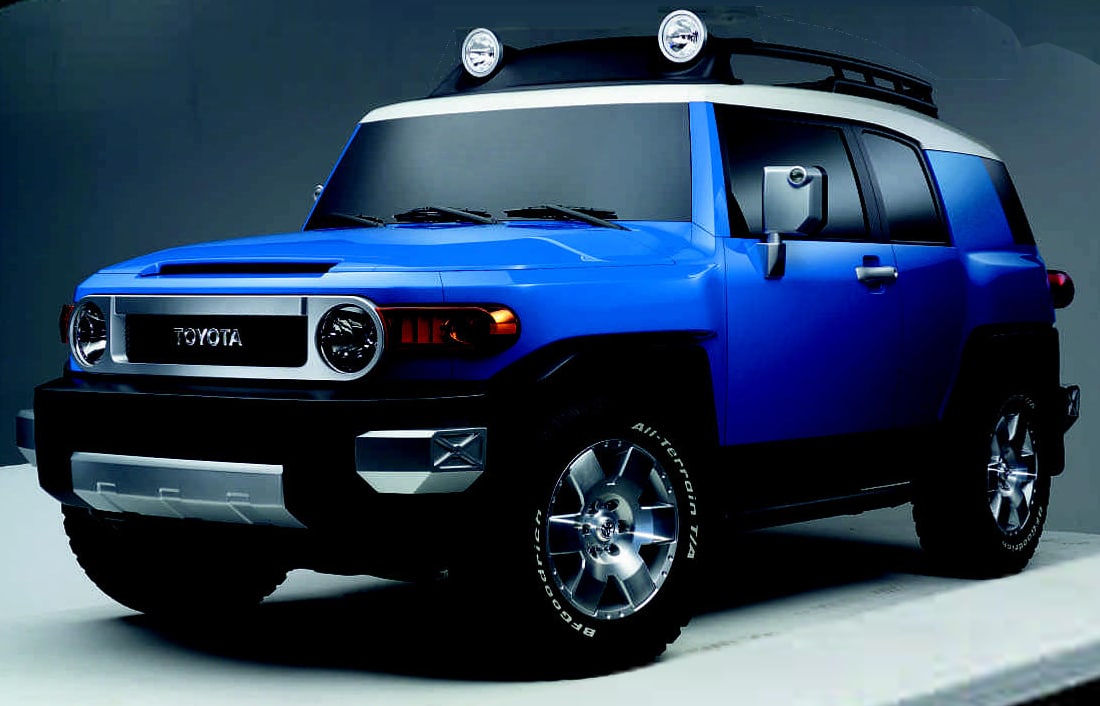
During the Toyota FJ Cruiser launch, the marketing team used a unique, and never heard of, approach when bringing the vehicle to market. They called in help. And this came from a team of volunteers they dubbed the FJ Cruiser Trail Teams.
These volunteer gave up months, and for some even years, of their time, and worked alongside Toyota engineers to learn all about the vehicle and then to drive it, really drive it and cement its place as still one of the most iconic Toyota vehicles owners still love to this day.
This is their untold story from the beginning since I was there for all of it.
New Product Development – Secrecy is Critical
Whether it’s a new model of a cellphone or computer, or a never-been-seen future truck model, secrecy is essential with early prototypes before the new product is launched into the market.
During the long development process of a new car or truck, sample units of the future vehicle are hand-assembled years before the start of production in order to verify the assembly process and to be able to evaluate durability, crash worthiness, and fuel efficiency before the design is completed. Called “prototypes,” early ones look pretty rough, but later-built prototypes might be indistinguishable from the final production units. Automakers used to make hundreds of prototypes, each one a staggering expense. Today an automaker might make just a few dozen prototypes for a new model. In addition to the tests conducted by various engineering teams, a small number of late prototypes are used to develop marketing materials and for photography and filming to create advertising content.
Secrecy around engineering prototypes isn’t just due to the natural reticence of engineers. There are several reasons why a company wants to carefully manage the visibility or release of information about prototypes:
- If the new product will replace a current offering in the product line, letting word out too soon may hurt sales of the current model; this could force retailers to drop prices of any old models in their inventory, and could erode the demand for the new product.
- The manufacturer wants to prevent competitors from getting a head start on developing their own response to the new product.
- If mass-media coverage is planned for the launch period, you don’t want one or two news outlets to unfairly scoop the rest of the media.
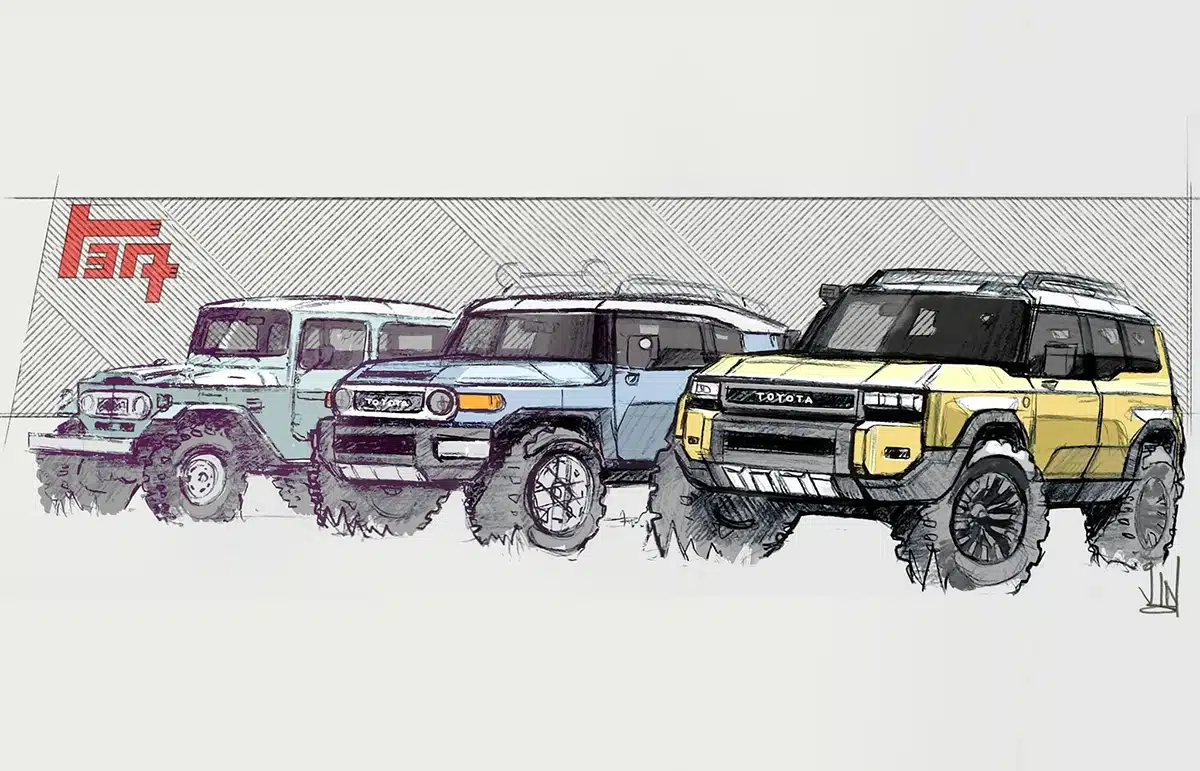
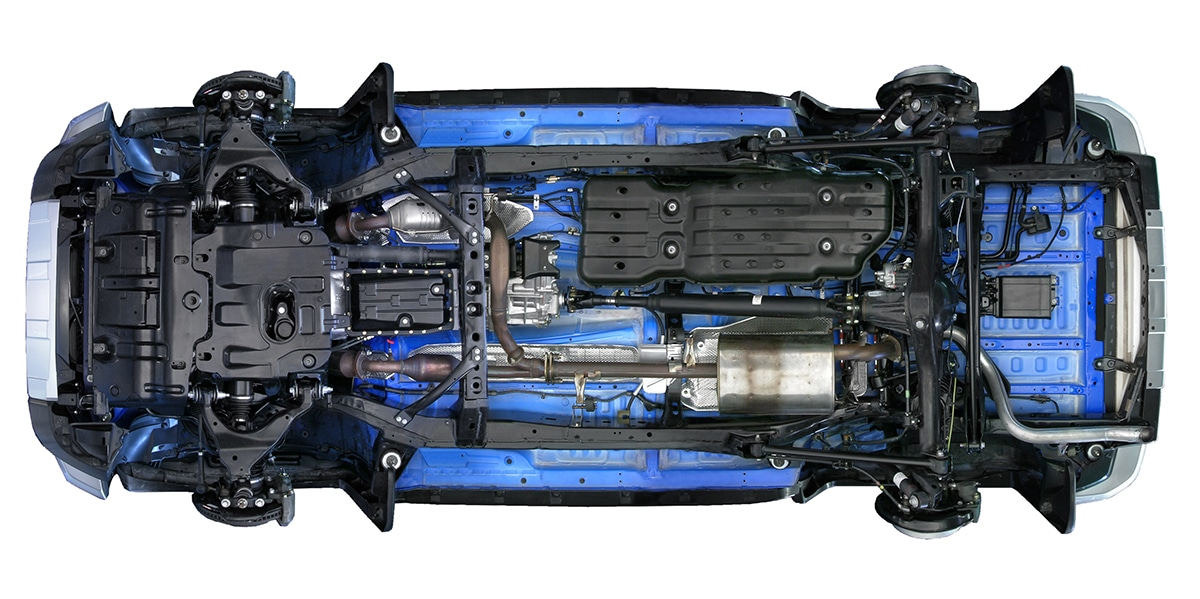
Some products don’t meet any of these criteria and we’re allowed, even encouraged, to get prototypes out and show them and talk about them early and often. The launch of the 2007 Toyota FJ Cruiser was one of those. A detailed press release had been issued in February 2005, and FJ Cruiser design sketches by Jin Won Kim of Toyota’s Calty Design Research in California had been shown publicly for years. It was obvious to the entire truck world that the FJ Cruiser must be built on the existing platform of the Toyota 4Runner and the Lexus GX 460, known as the Toyota Prado in other markets.
At its expected price point, the FJ Cruiser wouldn’t have been likely to introduce any amazing new materials, advanced technology or systems. The FJ Cruiser supplemented and did not replace any current Toyota models; it was planned as a small-volume model for a specific niche of buyers, so there wouldn’t be a big media splash.
Launching the New Truck
(image by Toyota Motor Sales, USA, Inc.)
As the Toyota USA Product Education Manager at that time, I worked with Truck Marketing Manager Paul Czaplicki and the Public Relations Department to plan and develop journalist presentations and training for the staff of the 1,200 Toyota dealers in the U.S. Taking advantage of this unusual opportunity for openness, in 2005, Paul Czaplicki came up with a fresh proposal to introduce the FJ Cruiser a year before launch using durability-test prototypes after Engineering was done with them in a unique guerrilla marketing activity. I had been reading about and learning about the FJ Cruiser, but hadn’t been able to drive any of them until Czaplicki asked me to help with his new idea called the “FJ Cruiser Trail Teams.”
FJ Cruiser Trail Teams
(image by Toyota Motor Sales, USA, Inc.)
What were the FJ Cruiser Trail Teams? Even years later I have a tough time describing them. I’m pretty sure what they were not: they weren’t salespeople with laptops or pads of triplicate orders forms (“Would you like yours in Solar Yellow or Voodoo Blue?” – “How about those alloy wheels!”). They also weren’t professional hotshots showing off their technical expertise on impossible obstacles in completely built custom trucks with unobtanium birfields, hyberbaric suspensions, and computer-controlled sway bars. They definitely weren’t corporate spokesgeeks pitching the brand, taking opinion surveys, and doing focus groups for future products.
Trail Team members came from every corner of the U.S.: Czaplicki and a team of event producers led by Kevin Holt of George P. Johnson Co., recruited volunteers at Toyota and Land Cruiser club off-road events from the Everglades to Puget Sound, from Anza Borrego to Tellico, from Minnesota to Texas during 2005. What every candidate had was spare time or a very understanding family: Czaplicki needed just eight months out of their lives.
All of the recruits had off-road driving experience, but their skill levels were as varied as the terrain they were used to driving. What they all shared was a devotion to off-road driving, to treading lightly, and to their favorite Toyota: Maureen Turner loved her second-generation 4Runner; Gustaf Kupetz and Robbie Antonson had FJ80s; Ron Quitevis built a rock crawler that used to be a Tacoma, I think. Tim Scully and a few other team members parked perfectly capable Defenders for the duration of their tour of duty.
Grand Junction, Colorado was Our Playground
(photo by Paul M. Williamsen)
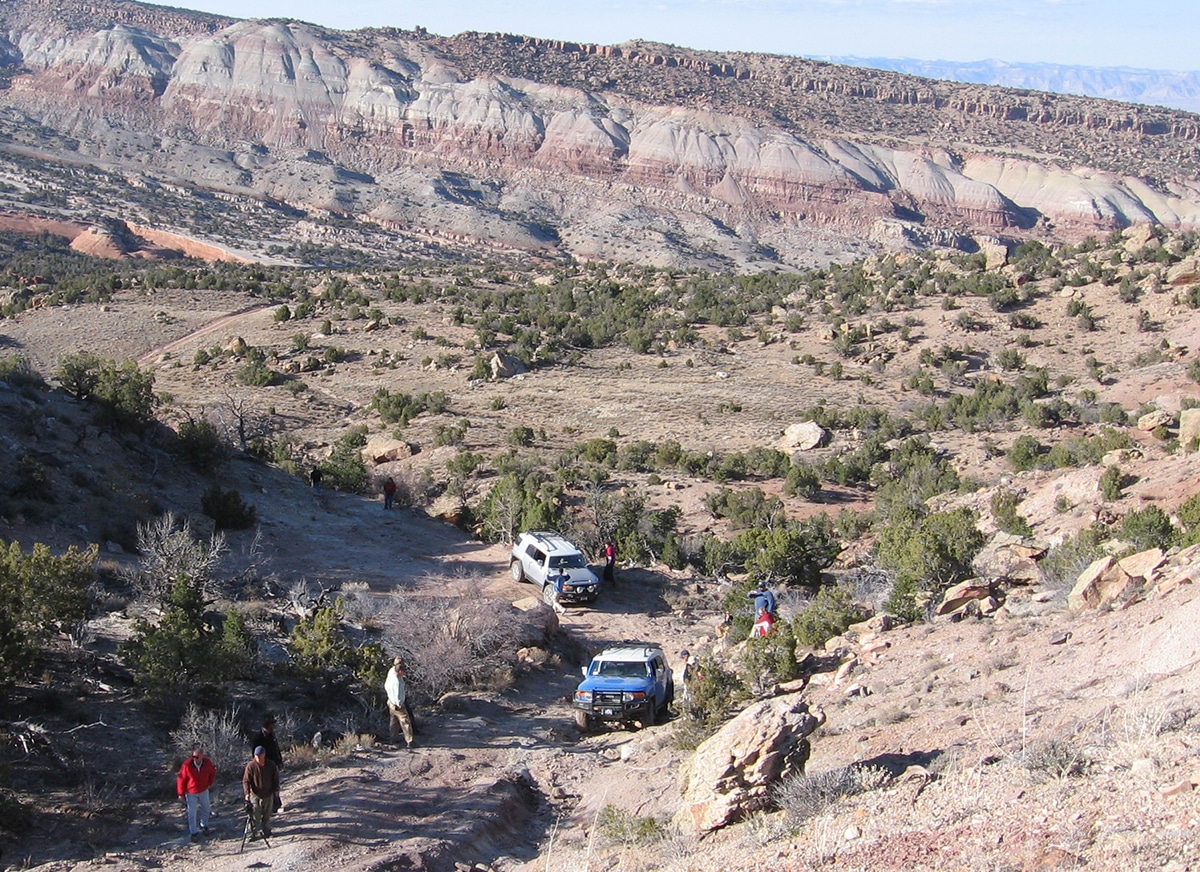
Blazing through western Colorado on I-70, squinting into the sunset late to Moab or Cedar City, or blinking into the sunrise towards Vail or Colorado Springs, have you ever stopped at Grand Junction to top up your tanks? Have you stood there, listening to the dollars zing through the pump, mesmerized by the colorful strata of the high mesas encircling the confluence of the Gunnison and the Colorado Rivers thinking “I bet there’s some good ’wheeling back up in there…”?
There is in fact wonderful ’wheeling up there, and it’s surprisingly easy to get to. So easy, in fact, that in March 2006 we brought a bunch of enthusiasts who had never even met each other went into those hills every day for a week in brand-new, never-been-driven, prototype Toyota FJ Cruisers. And came out safely every evening, often far past sunset, with nothing worse than desert racing stripes to show for it. This was the orientation and training for the FJ Cruiser Trail Teams.
The Trail Team recruits came to Grand Junction to learn what they had signed up for and meet for the first time. Toyota needed to know how well the team members could live and work together with people they’d never met, pulling their own weight and their co-driver’s weight, and still have nice manners after a 24-hour day in the saddle with the promise of a damp tent on wet pine needles at the end of the drive.
Trail Team Boot-Camp
(photo by Paul M. Williamsen)
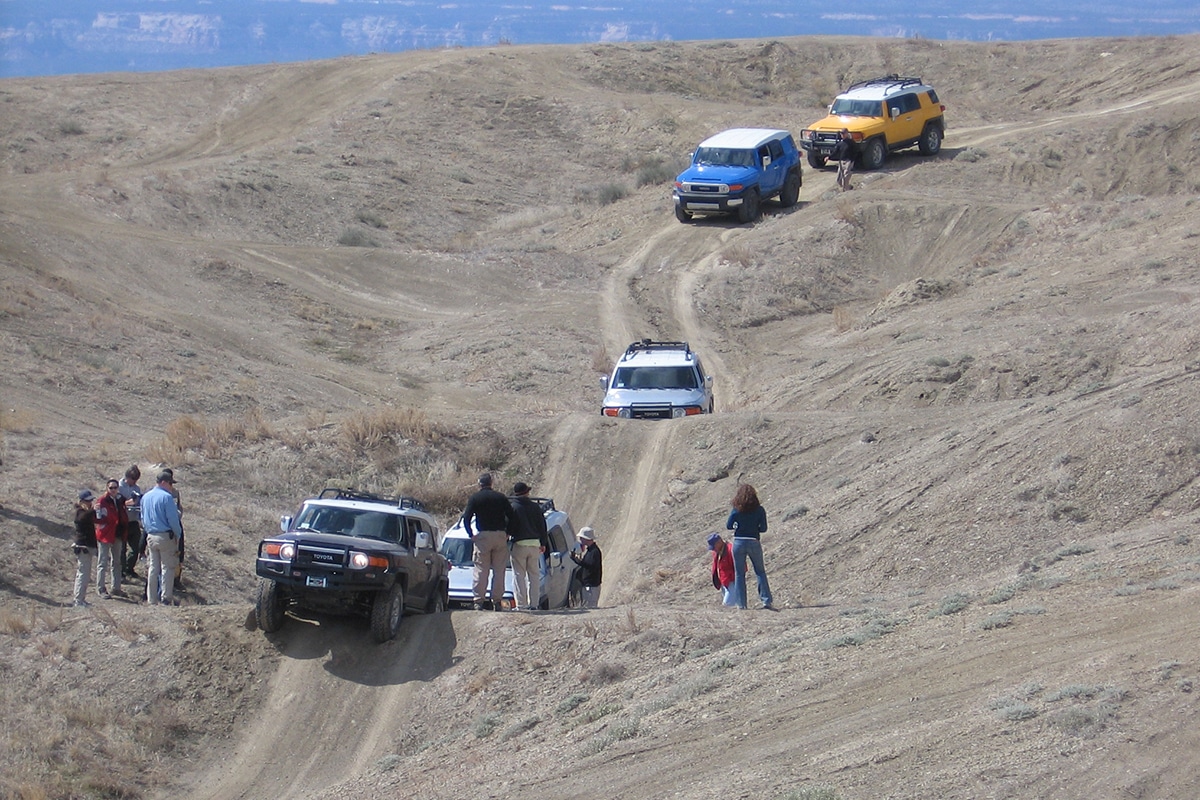
By the end of the week the recruits were to be paired up in teams of an experienced lead driver and one or two other drivers; each team also carried a producer and an assistant to upload photos to the website, take care of the arrangements and the bills, the tools and supplies, and most importantly, the T‑shirt and freebies inventory. They all had to fit in two pre-production FJ Cruisers, each pulling a small enclosed trailer to haul their gear and swag.
Trail Team members were challenged with an off-road boot camp planned by Bill Burke, legendary Camel Trophy Truck winner, offroad trail guide and owner of 4‑Wheeling America in nearby Fruita, Colo. Bill had been working with Toyota for years, advising Land Cruiser and Sequoia engineers, and helping with the critical final testing and tuning of FJ Cruiser prototypes. Aided by fellow Camel off-road legends Tom Collins and Lee Magee and young driver Chris Nelson, Bill planned a week that flowed through the beautiful mesas around the Grand Junction valley and trained team members in basic off-road techniques and terminology, safety and recovery techniques, and prepared them with team-building activities, environmental sensitivity and other character development.
Training the Trail Teams
(photo by Paul M. Williamsen)
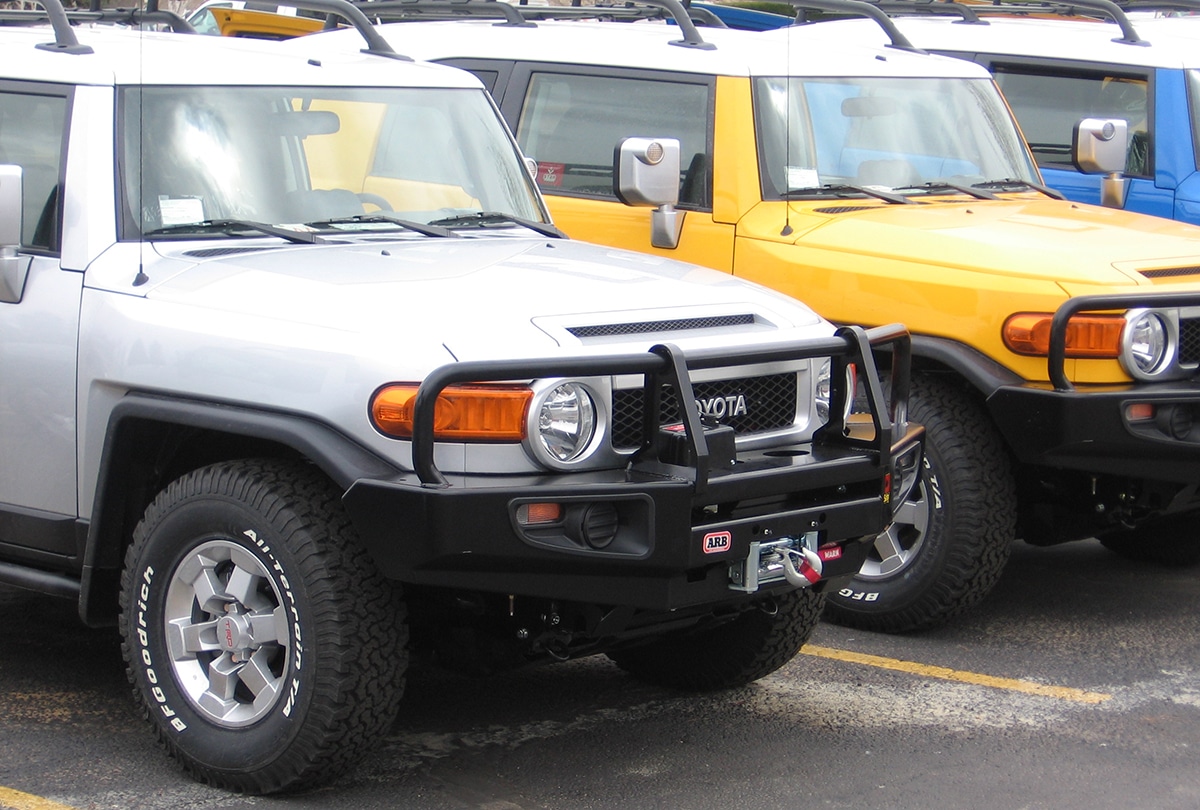
My job was to introduce the Team members to the engineering, product features, and operation of the new FJ Cruiser, then take them to the hotel parking lot to see and drive their new FJs for the first time. There was a colorful crayon box of eight trucks: some of them early hand-built prototypes, the others early-production test units built for quality control checking. It was the teams’ job to check them out – thoroughly.
During their first-ever drives in the FJ Cruisers looping around downtown Grand Junction we were trailed by local fans in old HiLuxes and new Tacomas, plus our own camera crew from Warren Miller Productions. The three earliest prototypes wore standard 17” Dunlop mud & snow tires on retro black steel wheels while the later pre-production FJ Cruisers had the optional 16” B. F. Goodrich All-Terrain tires on TRD 6-spoke alloys. The trucks were unmodified except for rock rails and full skid plates underneath. The Trail Team members found the door handles, the best seating positions, the mirror controls, and the blind spots. They also found the sweet spot in the torque curve, reverse on the six-speed manual, and neutral on the transfer case lever.
Late on the first day they also learned that in a convoy, the most important car to watch is not the one you’re following, it’s the the one behind you: they lost three trucks after a gas stop. As the lead driver of the first of the ‘lost’ trucks, I had to guess where I thought Bill might have taken them when they left the gas station, and instructed my small team to go the wrong way at a good clip for 18 miles trying to catch up before it became clear that Bill had actually gone the opposite direction.
Off-Roading the FJ Cruiser
(photo by Paul M. Williamsen)
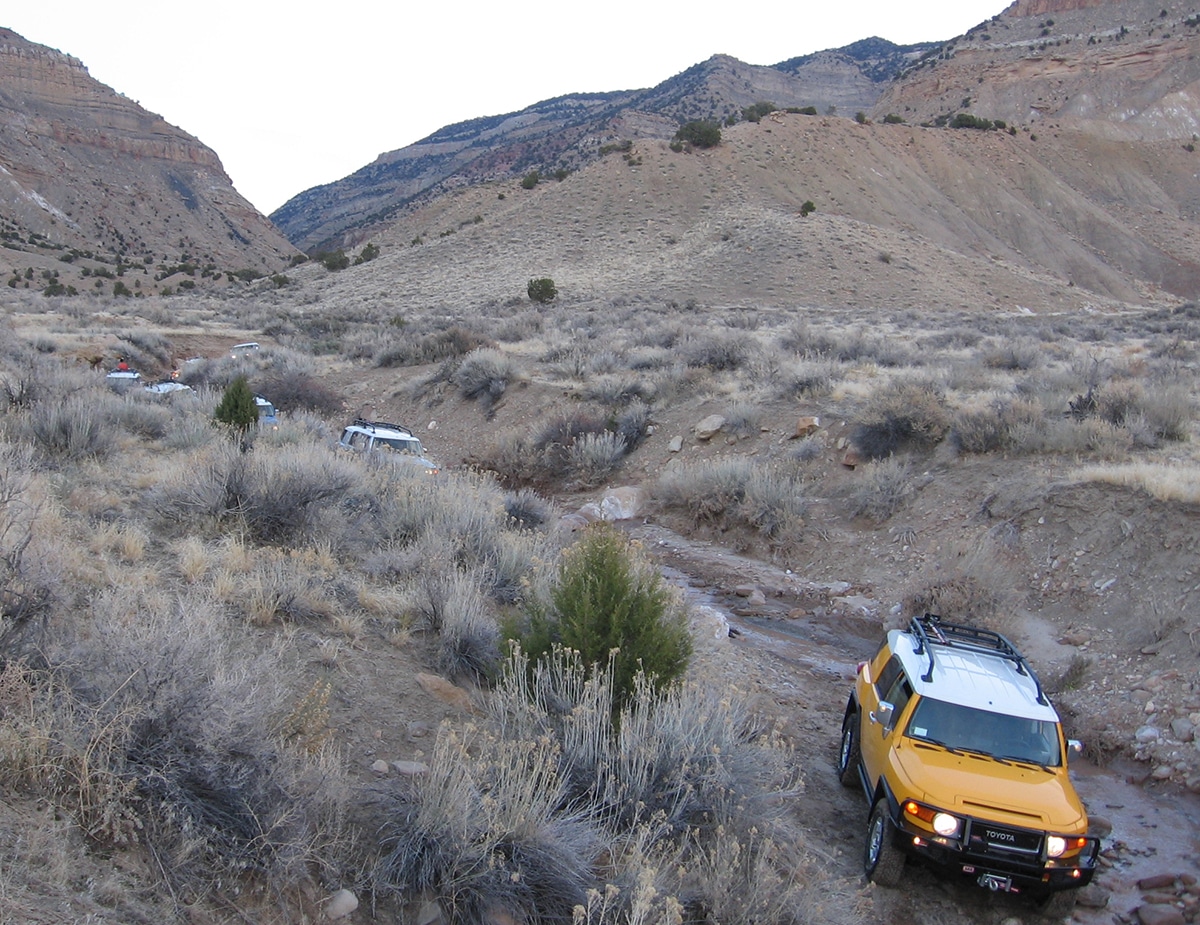
Bill had led the convoy to Area 21, an accessible entry into the foothills of the mesa north of Fruita, and by the time we caught up and got to the end of the pavement, there was nothing to see but a few fresh tire tracks that disappeared where the trail forded a creek.
Turning off the road where I thought they might have gone, we drove upstream slowly over obstacles I wouldn’t have gone over myself in a prototype truck, much less a stock one. Fresh wet tire prints on the rocks confirmed we were on the right trail – in the right creek. As dusk approached we were relieved to see the glint of headlights coming downstream at us, followed by a row of white roofs bouncing above the creek banks.
Tuesday, the teams learned trail first aid, got a primer in public speaking, and learned how to use the digital cameras to post pictures to a corporate website. Bill and I really wanted the point about convoy etiquette to sink in, so I came up with a trick to make one truck from each team not run the following morning. I snapped the cover off of the fuel pump relays of half the trucks and put a little bit of clear tape between the contacts, ensuring that the truck would crank just fine, start once, then die. This pulled each team together for some fast trouble-shooting. (In-the-field Diagnostic Tip: If you suspect a bad relay, try swapping a known-good relay from some other circuit that has the same color and same pin configuration as the suspect relay – in this case, swapping the horn relay with the fuel pump relay made the FJ Cruisers start and run.) Within minutes all the teams had all their trucks streaming out of the parking lot. And they never lost another truck all week.
(photo by Paul M. Williamsen)
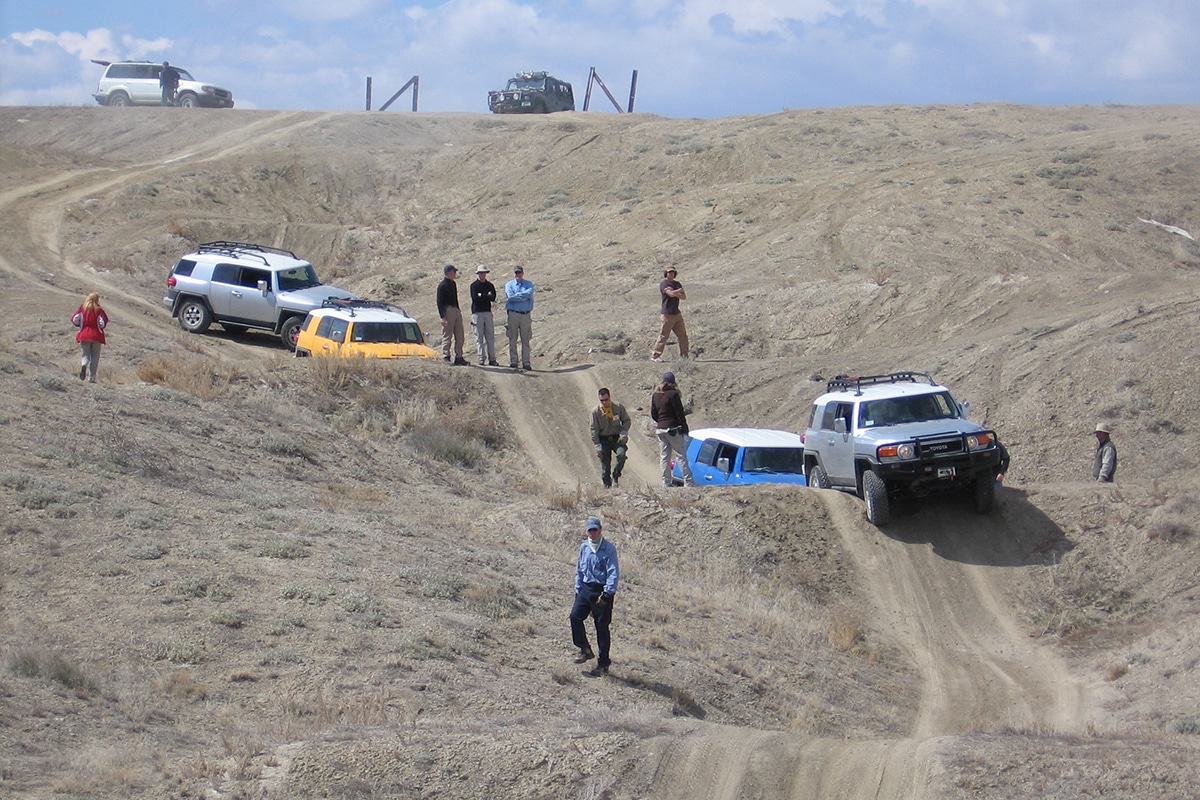
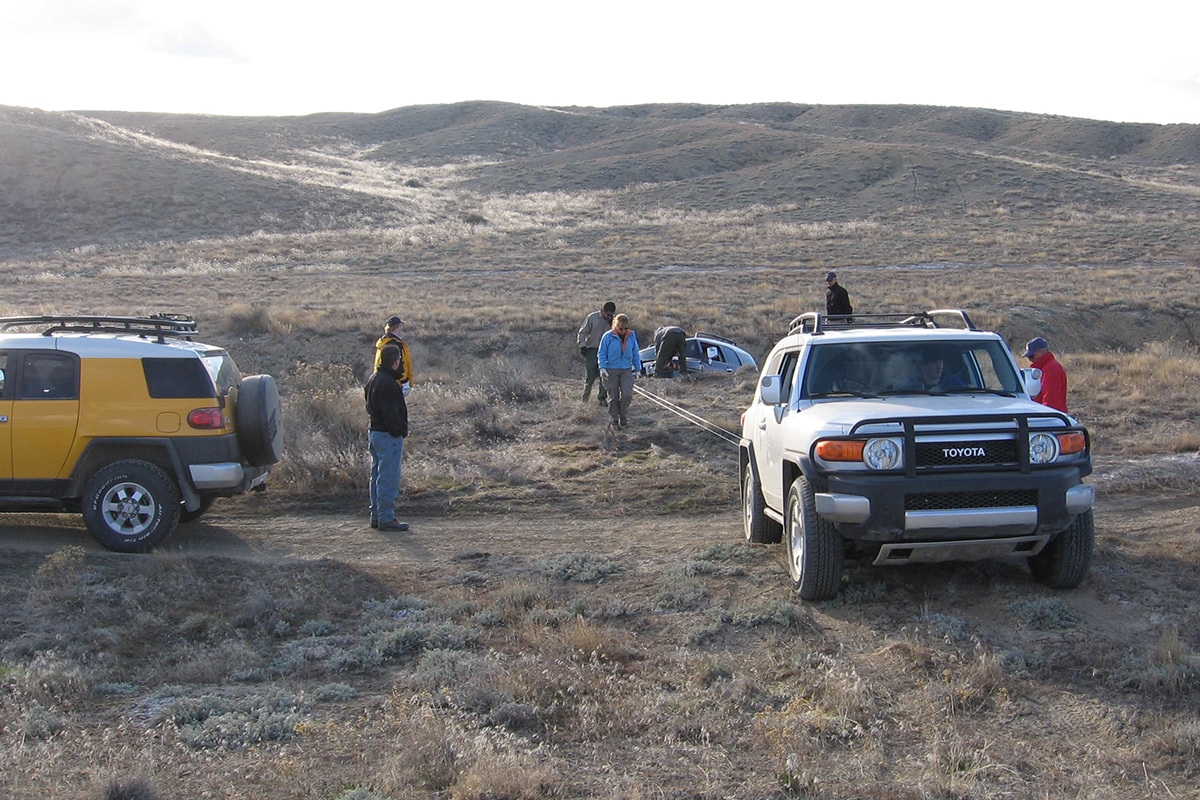
In the shale hills beyond the airport east of Grand Junction, the teams went up the front and down the back of a decommissioned dam to learn about approach and departure angles. The team members learned what 30° of side slope looks like with the narrow windshield all tilted over, experienced break-over angle up close and personal, and stared into the abyss of a 40° descent. We worked late into the afternoon practicing recovery techniques with winches that had been mounted to custom bumpers on the pre-production trucks the night before by Jim Jackson of ARB USA. The FJ Cruisers with the bumpers and the winches gave up some break-over angle and lost about ¾” of ground clearance under the front cross-member.
(photo by Paul M. Williamsen)
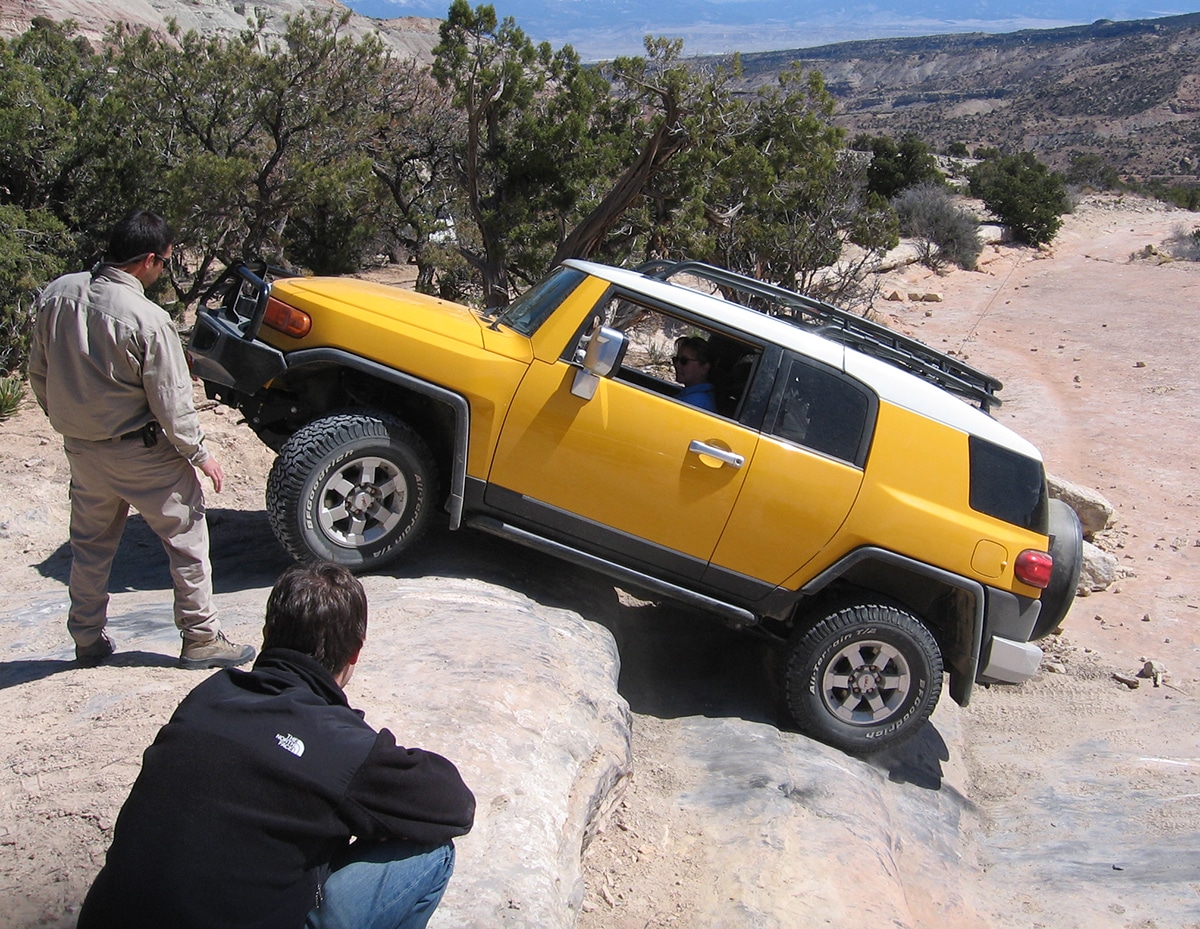
On the third day we skipped the classroom stuff and made an early start south of town for the Bangs Canyon OHV area, trailed this time by a TV reporter and cameraman from the local ABC affiliate. On the slabs just around the bend from the Tabegauché load-in area, the Trail Teams practiced hard-rock ascents. With spotting from Tim Scully, Maureen was the first to conquer the five-foot step in the yellow FJ.
(photo by Paul M. Williamsen)
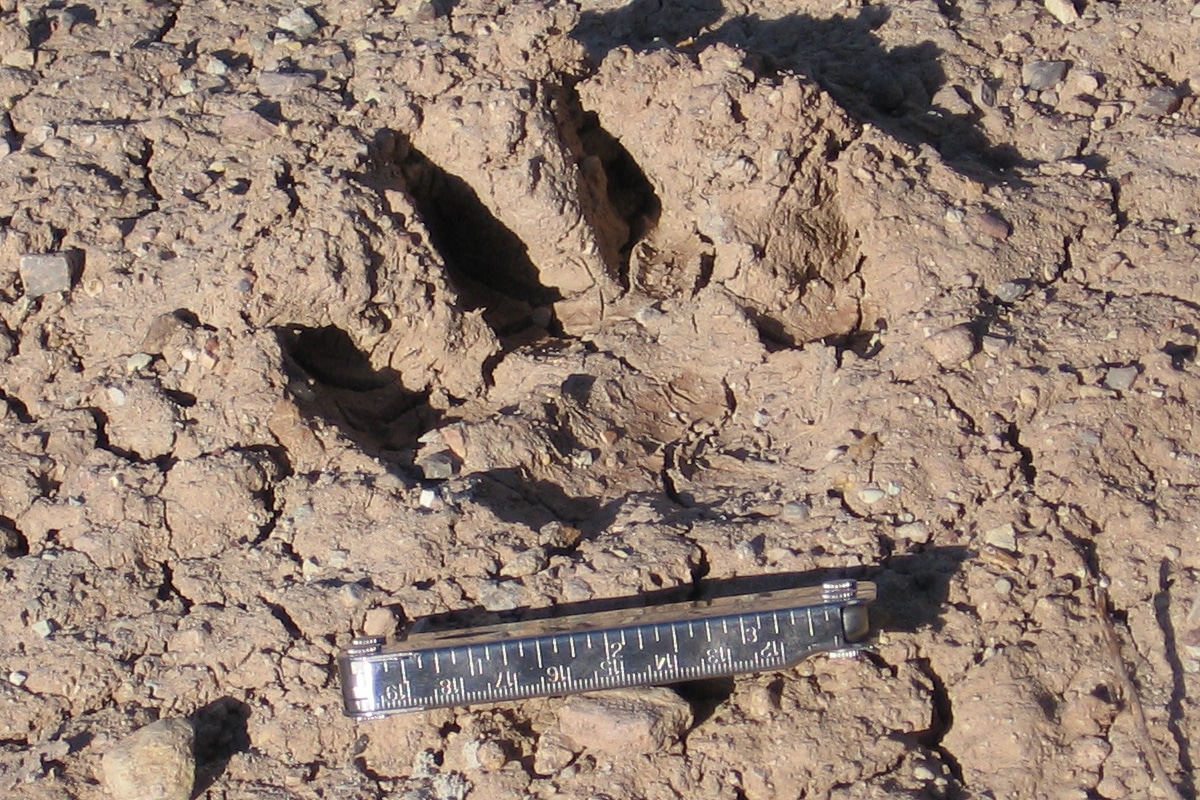
The teams practiced using the Hi-Lift jacks, including painful, but necessary, winching with nothing but hand power. That’s why we pack these things in, after all. Wednesday was a long one: the FJs didn’t get out of second gear all day. The teams still had to learn about hand signals, picking lines, crossing trenches diagonally, and what a 4” wide footprint of a mountain lion looks like.
(photo by Paul M. Williamsen)
Finally we crossed treacherous mounds of slushy, wet, bentonite high in the mesa with Bill Burke and Jay Tischler spotting, before turning around to head back down as the lights twinkling in Grand Junction below us to the north guided us in. The special courtesy lights on the rearview mirrors of the FJs made it easy to identify our team members behind us on the darkening trail.
Trail Team Life
(illustration by Toyota Motor Sales, USA, Inc.)
By Thursday the teams were working well together, and working hard. They’d become considerate, Zen-like companions on the trail. They tried on their new “FJ” trail uniforms. Most of all, they were anxious to try out sixth gear in the manual transmissions and start unrolling some scenery in front of the upright windshields of their FJ Cruisers.
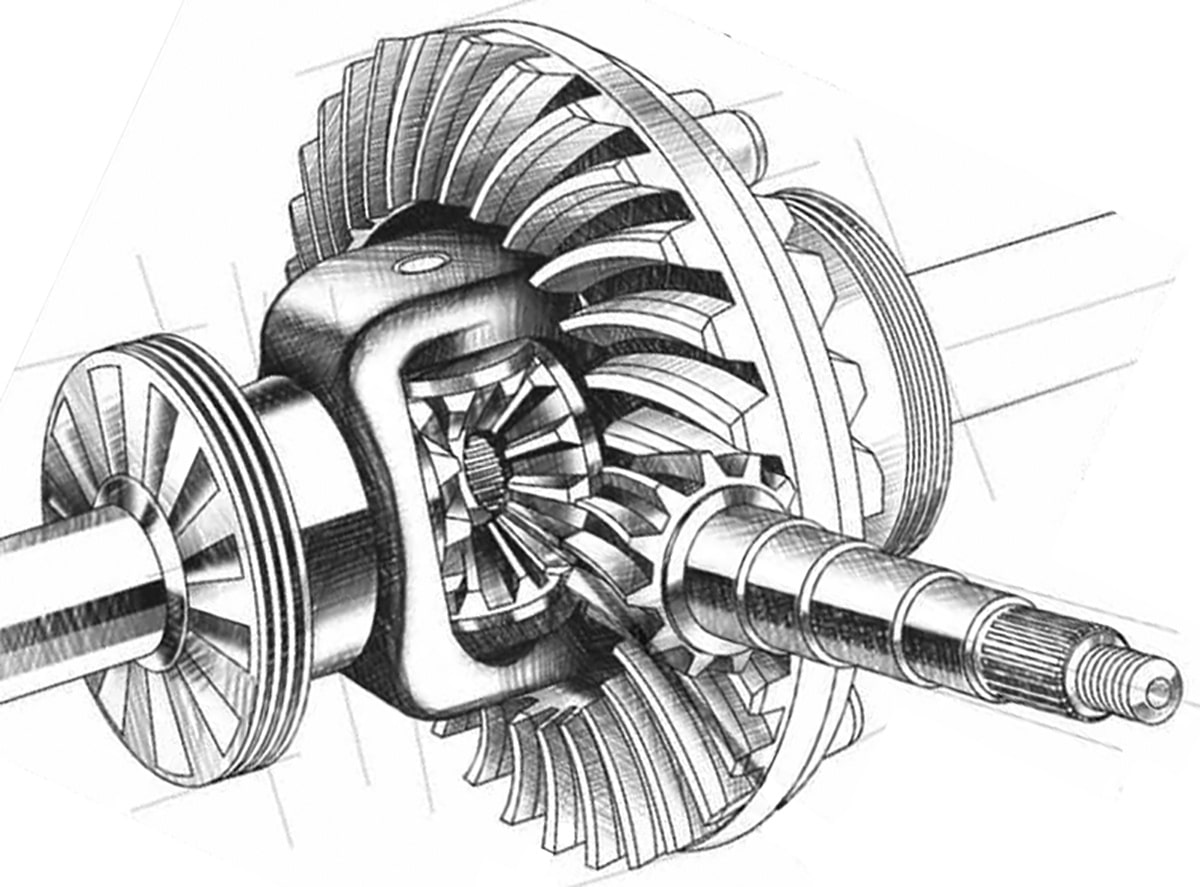
During the spring and summer of 2006 the FJ Trail Teams were seen at public offroad events at Sandy, Utah, at Hungry Valley in Gorman, California, and above the ski slopes of Aspen, Colorado. They went to the Badlands of South Dakota, over to Tellico, through Moab and over the Rubicon. The teams helped to mark trails, administered first aid, swept trails at the end of the day to recover stuck vehicles and pick up trash. In the evening the Trail Teams hosted free camp meals and showed off-road racing films on inflatable movie screens. They learned how to tighten the bolts that hold the rock rails on and one team learned to replace a rear differential in the field (it turns out that a pumpkin from a Tacoma fit the early FJ Cruiser axle housing without too much trouble).
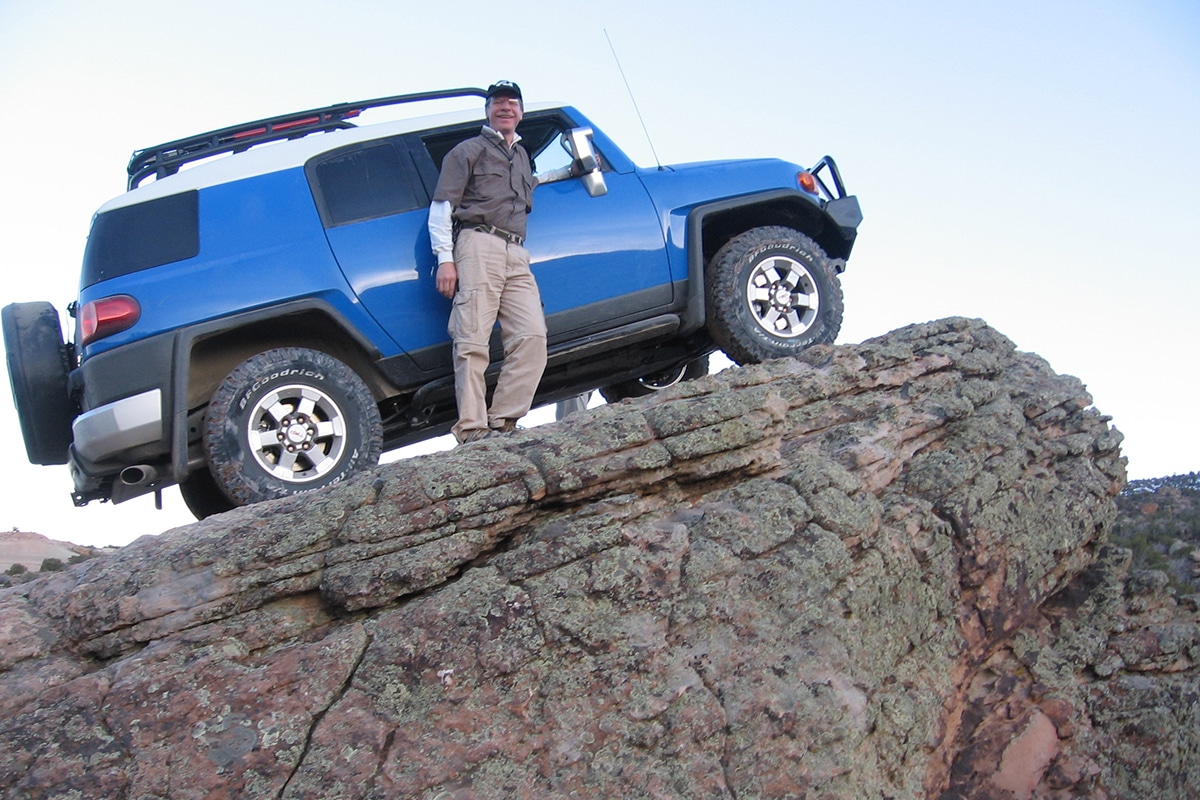
The Trail Teams drove their FJ Cruisers until after the passes snowed over in November 2006. The program was so successful that Paul Czaplicki got funding to repeat the Trail Teams program in 2007 and again in 2008. Many Trail Team members were happy to do a single season on the trails before getting back to real life, but each year a few carryover members remained to help the rookies. The success of the FJ Trail Teams also convinced Product Planning to develop the special “Trail Teams” offroad package for the FJ Cruiser as a single-month build of specially-equipped trucks in a unique color each year.
(photo by Paul M. Williamsen)








1 reply
Loading new replies...
Administrator
Well-known member
Join the full discussion at the Forum Pickuptrucktalk →