
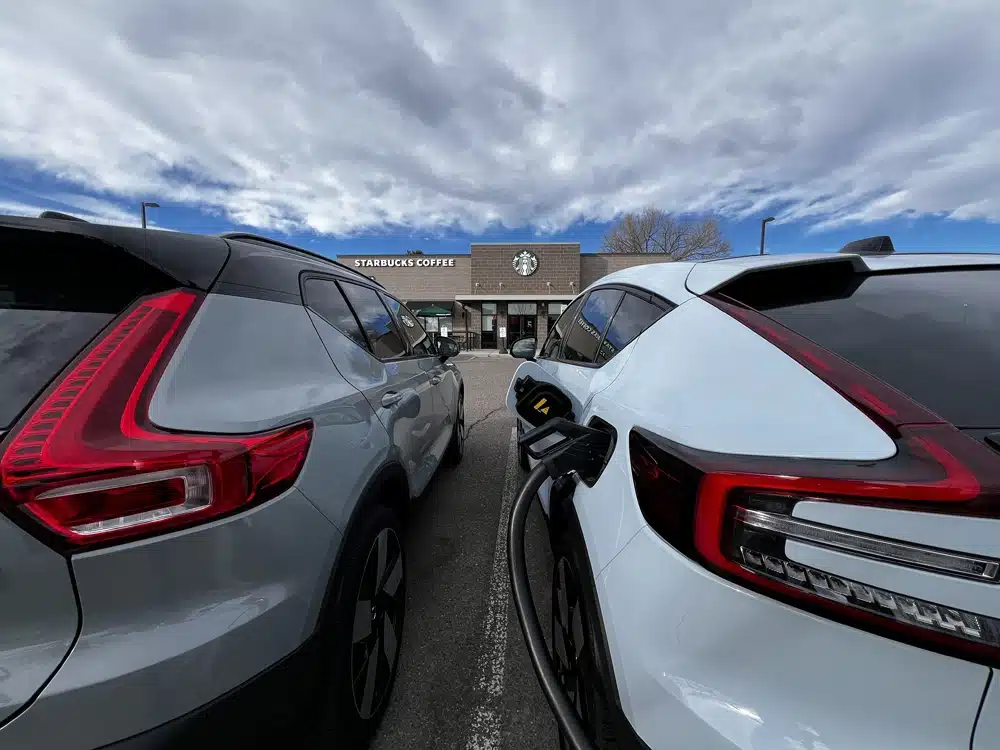
You have to be a little bit crazy to consider doing a 1,350-mile road trip in a rear-wheel-drive EV through mountains in the winter. So, when Volvo asked me to participate in a trial run of its new EV charging network at Starbucks from Denver to Seattle in 2024 XC40 and C40 RWD models at the beginning of December, I immediately said yes.
What’s the worst that could happen?
The Volvo, Starbucks partnership
Volvo announced it was partnering with Starbucks in March of 2022 to install chargers at 15 stores from Denver to Seattle, covering 1,350 miles from point to point. The chargers, powered by ChargePoint, started to go online in December of 2022, and a year later, nearly all the chargers are operational.
The idea is to have chargers available at least every 100 miles along the often-remote route, which had previously been severely underserved. The chargers themselves deliver between 125 and 200 kW – and can bring a C40 or XC40 from 20% to 90% in about 40 minutes.
So, naturally, it makes sense to test the route in the winter with RWD models.
How was the EV charging network?
As I worked my way through the holiday lineup of lattes at Starbucks (Sugar Cookie was the clear winner, though the Chestnut Praline was a close second), we hit 13 of the 15 charging networks, We skipped the one in Provo, Utah, because we didn’t need the charge, and we missed the one in Issaquah, Washington, because it wasn’t fully operational yet.
Overall, the experience was delightful.
The XC40 and C40 accept up to 200 kW of power, which is fast but not ultrafast. However, having driven a couple of those ultrafast-capable EVs recently, I’ll point out I’ve never gotten up to 350 kW of power delivered. Ever. I usually max out around 100 or 115 kW – and that was the case here as well.
What you need to know if you’re a neophyte EV driver is that multiple chargers at a stop often split power. So, if you stop at a two-charger station and that station delivers 200 kW of power, two cars plugged in at the same time will share that power. So, whoever plugged in first, gets the bulk of the power up front, but as their “tank” fills, the power starts to balance and then shift to the EV with less of a charge. After a battery reaches 80%, the charge will trickle, often at 10 to 20 kW. ChargePoint will even begin charging you extra at that point – in our case it was 25-cents a minute – to encourage you to unplug and be on your way. If there are four chargers at a stop, the same theory applies, but it’s usually divided two and two. So, the two closest to each other will split the power, and the next two will split power. So, if you pull up to a four-charger station and one car is already plugged in, it’s in your best interests to use the furthest charger away from the car already plugged in.
I will say Volvo did us a solid by planning out the route and giving us a minimum charge we needed to reach before departing each station. So, in some cases we were in and out of Starbucks in 20 to 30 minutes after grabbing a beverage and taking a pee break. Sometimes we were there an hour or more if we needed to get to 90% or 100% for a particularly long stretch – there were some parts of the drive that were nearly 200 miles long. Through mountains. At 32 degrees.
So, how’d did the Volvo XC40 and C40 do?
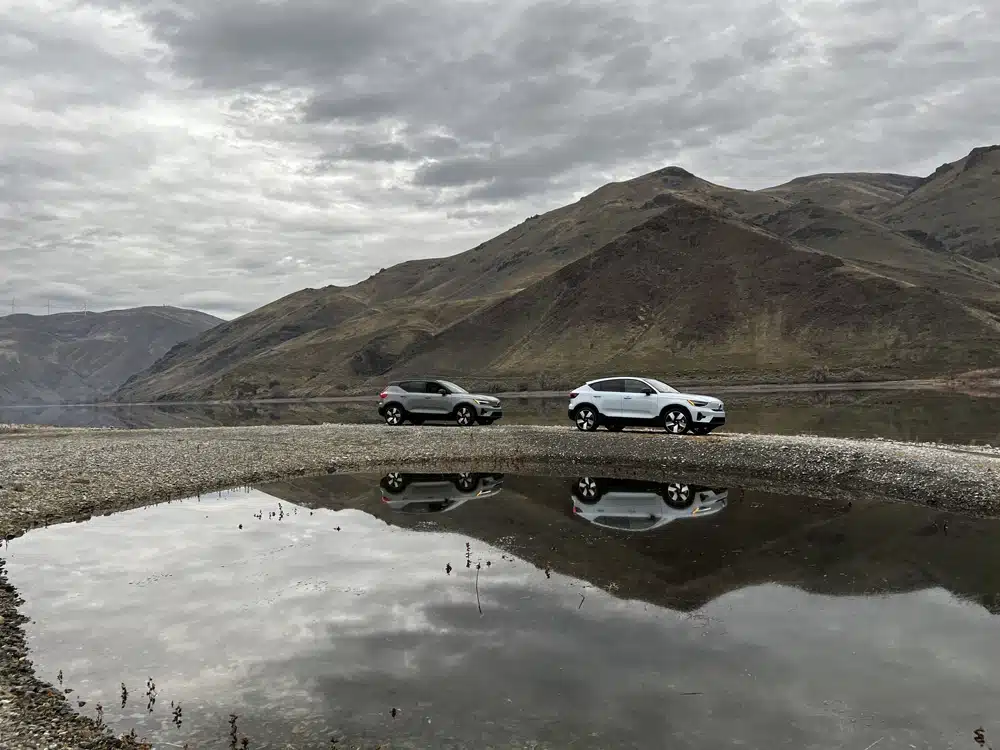
The 2024 Volvo XC40 and C40 with RWD and the extended-range battery can get up to 297 miles of range, but I’ll be honest, even at 100% we never saw those kinds of numbers – even before we started driving and the machine learning had a chance to familiarize with our driving styles.
However, what is totally brilliant about the Volvo setup is that when you use the native navigation, which is powered by Google, the system gives you an accurate estimate of how much battery you’ll have when you arrive at your destination. I’m going to put a stress on the word accurate because outside of Volvo or Polestar vehicles, I’ve never (read: never ever) gotten an accurate arrival range from any other EV.
There was one nail-biter 191-mile stretch where the vehicle estimated we’d arrive with 10% battery left. Since 10% isn’t 0%, we said a little prayer and stuck pretty close to the 70-MPH speed limit. When the temperatures were around 40 degrees and we were descending, the range crept up close to 20% at one point, then the temperatures dropped, and we started to climb. The range started its downward slide as well, and we dropped our speed to 65 MPH. There was an Electrify America station about 20 miles from our final destination, and we did consider stopping. But since the estimate never dropped below 10%, we figured we’d risk it.
We arrived with 12% battery remaining.
I have to admit I like the idea of looking at percentages instead of miles because 12% somehow seems a little less nerve-wracking than 30 miles. Plus, while the mileage waxes and wanes, we found the percentages (unless we were climbing and descending) stayed fairly consistent.
I’d say 12 times out of 13 we arrived at our destination within 1% or 2% of what the original estimate for arrival was. The one time we were off, it was only 10% less — and there may have been a detour involved.
In order to be this accurate, the Volvo system talks with the Google system and takes into account things like elevation, temperature and distance. Over 1,350 miles and four days of driving, it worked really, really well.
Oh, and the seats, after a couple of 12-hour driving days were super comfortable from beginning to end.
Range anxiety-less
Other than that 10% nail-biter, I never really experienced range anxiety during the drive. We were in the C40 for two days and then swapped into the XC40 for the final two. After the first day of accurate estimates, I trusted the vehicle to tell me if I could make it, and then I did. Most of the time we were driving between 70 and 85 MPH (speed limits in Utah are 80 MPH), and I was agog that the vehicle could manage long stretches at higher speeds in cold temperatures and still retain the accurate arrival estimate.
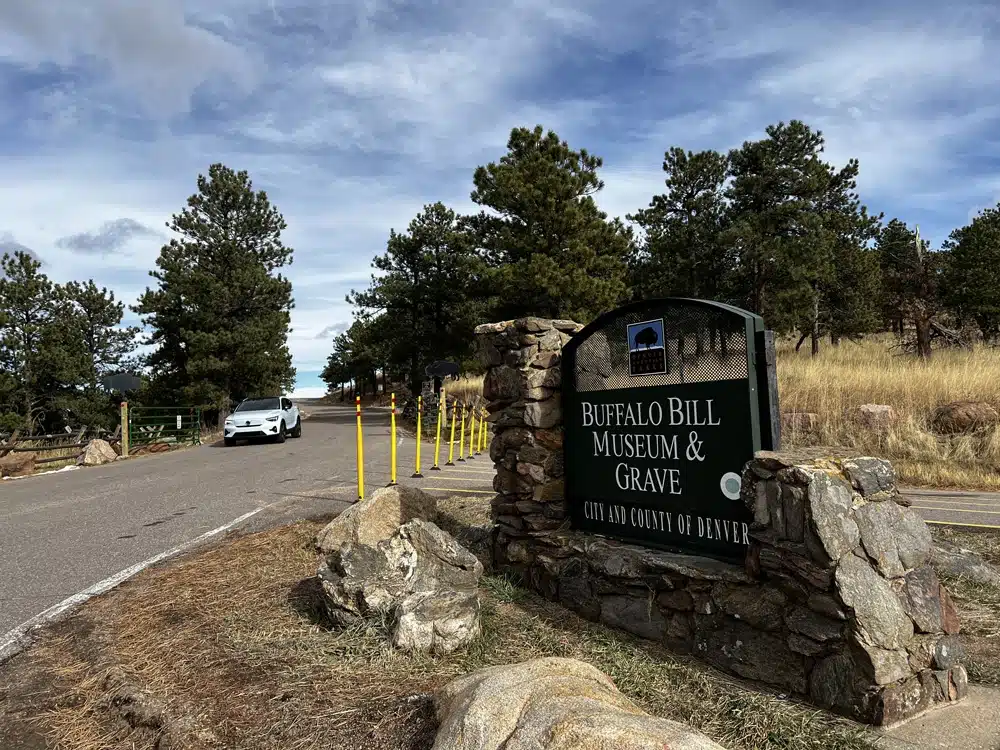
We took a couple of detours to see things like Buffalo Bill’s grave and a historically preserved grist mill. We took a couple of wrong turns – including one up a mountain that had been sanded but was still snowy and had no guard rails. And still we arrived with plenty of range as well as nary a slip.
There was fog, snow, sleet and rain, and never once did I stop to think: What if we get stuck or bricked?
The experience I had in the 2024 Volvo XC40 and C40 is the experience that every EV owner should have. And the charging experience at Starbucks (i.e. well-lighted and safe with food and bathrooms) is what EV owner should have access to.
A couple of hiccups
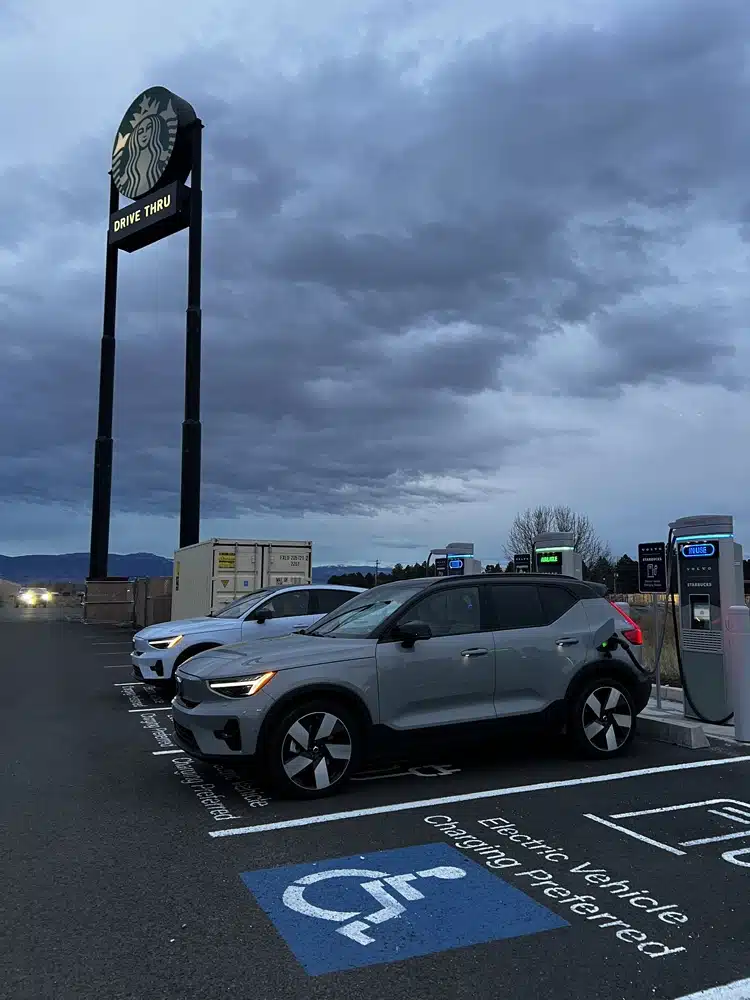
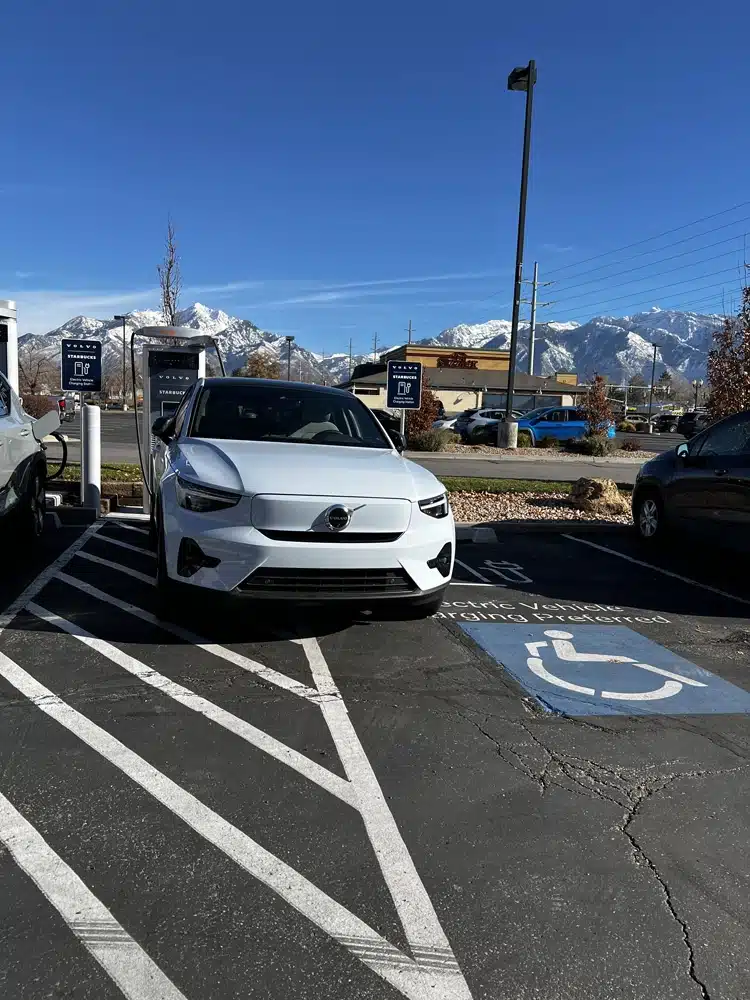
Of course, every pilot program and partnership has hiccups. First, I noticed at some stores where there were only two chargers available, one was reserved as a handicapped spot. Since there were two vehicles traveling along the same route and hitting the same Starbucks charging stations at roughly the same time, this posed an ethical dilemma for me: Do you park in the handicap spot to charge, or do you leave it open in case someone in need pulls up?
I’m not going to lie, if it was the only option, we took the spot. Though we kept an eye on the vehicle and sometimes stayed in the car while it was charging, just in case. While we didn’t encounter this at every stop, and some Starbucks had more than two chargers, this struck me as peculiar – especially since the handicap-marked spot wasn’t next to the door. In fact, none of the chargers were. So, why would you essentially block one charger for a spot that a handicap person probably wouldn’t use? To pile on, with the handicap access painted stripes near the charger, you can’t actually park within the lines and charge because the cord won’t reach. So, in addition to having a handicap spot in a location that’s not near a door, if a handicap person did park there to charge, depending on their mobility issue, they might not be able to exit the vehicle to charge anyway. All in all, it was poorly planned.
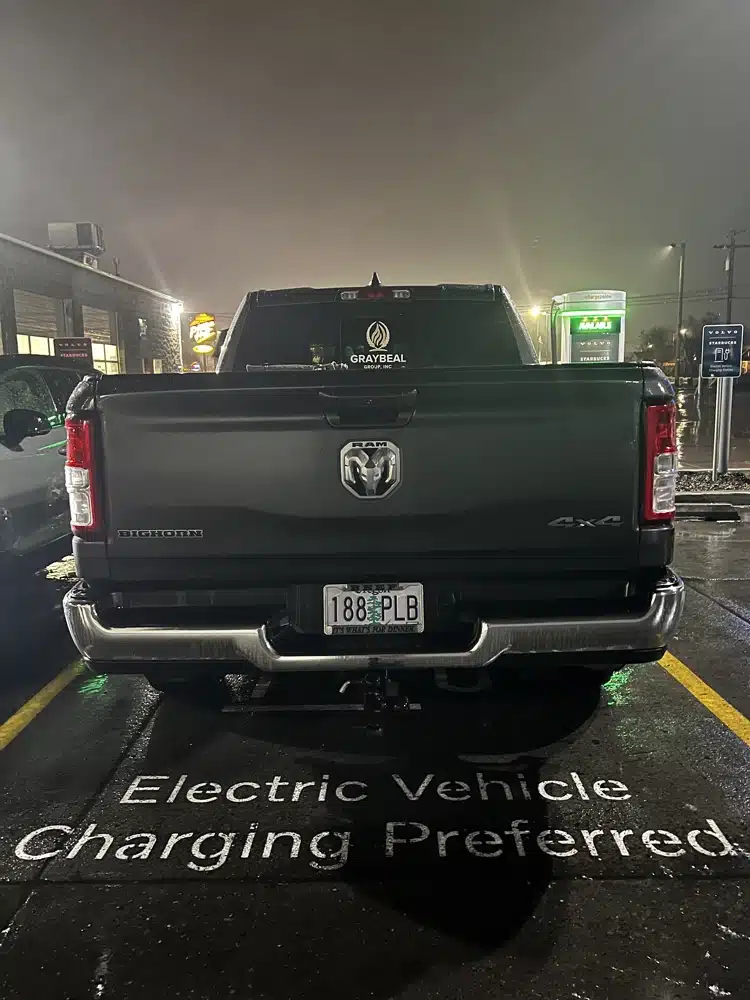
Another potential issue: Starbucks refused to mark the spots with “EV charging only.” Instead, it said “Electric Vehicle Charging Preferred.” This means an EV could park there and not charge, or as happened in Hermiston, Oregon, a Ram truck parked in one of the charging spots. And stayed there longer than we did. So, you could get ICED and have no recourse to get the offending vehicle removed. This is a big problem.
Two other issues are, in my mind, design flaws. One could be easily fixed, the other is a byproduct of the often-tight Starbucks parking lots. None of the chargers were covered. So, we stood outside a couple of times in pouring rain activating and hooking up the chargers. In a location like LA, that wouldn’t be an issue, but in the Seattle area? Well, um, get used to being wet if you need to charge. Also, all of the chargers were at pull-in spots. This means you could never use a Starbucks charger if you were in a truck or SUV and hauling a trailer.
The bottom line
I’ve said it before, and I’ll say it again, this is exactly how a charging network should operate. Warmth, safety, food and clean bathrooms? Yes, please! Plus, all the chargers worked. What a novel idea! Because the network is in partnership with Volvo, someone from Volvo is always watching them and immediately reaches out to ChargePoint when something is amiss. Plus, you have the staff at Starbucks who also keep an eye out.
While this is just a pilot program, the folks at Volvo have confirmed they’re hoping to expand, but they don’t have anything to announce just yet.
I’ve already put in my special request for a Chicago-to-Indy route.








4 comments
Orin
If a charger at a Starbucks isn’t working, the “partners” (their term) will be as able to help as they are if the WiFi isn’t working. Which is to say, not at all. The manager *might* have a phone number, but holding your breath waiting for a fix is not advised.
Jill Ciminillo
Volvo seems pretty committed to ensuring these stations are always up and running. As we were making the drive, there were a couple times that something didn’t seem to be working right, and Volvo had ChargePoint on speed dial.
David Holzman
My best guess is that my father made it from Denver to Pendleton, Oregon–1130 miles–in the 1950 Studebaker Champion in ~20.5 hours, on his first x-country trip, Boston to Seattle. He was trying to get from Denver to Seattle in a day. He hadn’t done his homework to figure out the distance. Having gotten the Studebaker’s gas mileage from the 1950 Consumer Reports, and the volume of the gas tank from the Studebaker Museum, I figured out he would have had to stop three times that day, and probably did everything at each of those stops and spent 15-30 minutes at each. He was trying to make it to Seattle in a day, ostensibly to be at the airport to pick up my mother and brother, and probably our dog, when they arrived (I wasn’t born yet). My cousin, Tom Hornbein, with two other guys, did drive from Denver to Seattle in a day years later, but his climb up Everest was much more impressive than that drive. He left his last name on the Hornbein Couloir, close to the summit.
Jill Ciminillo
Denver to Seattle is a hike! I can’t imagine anyone doing that in 24 hours!! It took us 4 days. 😳