
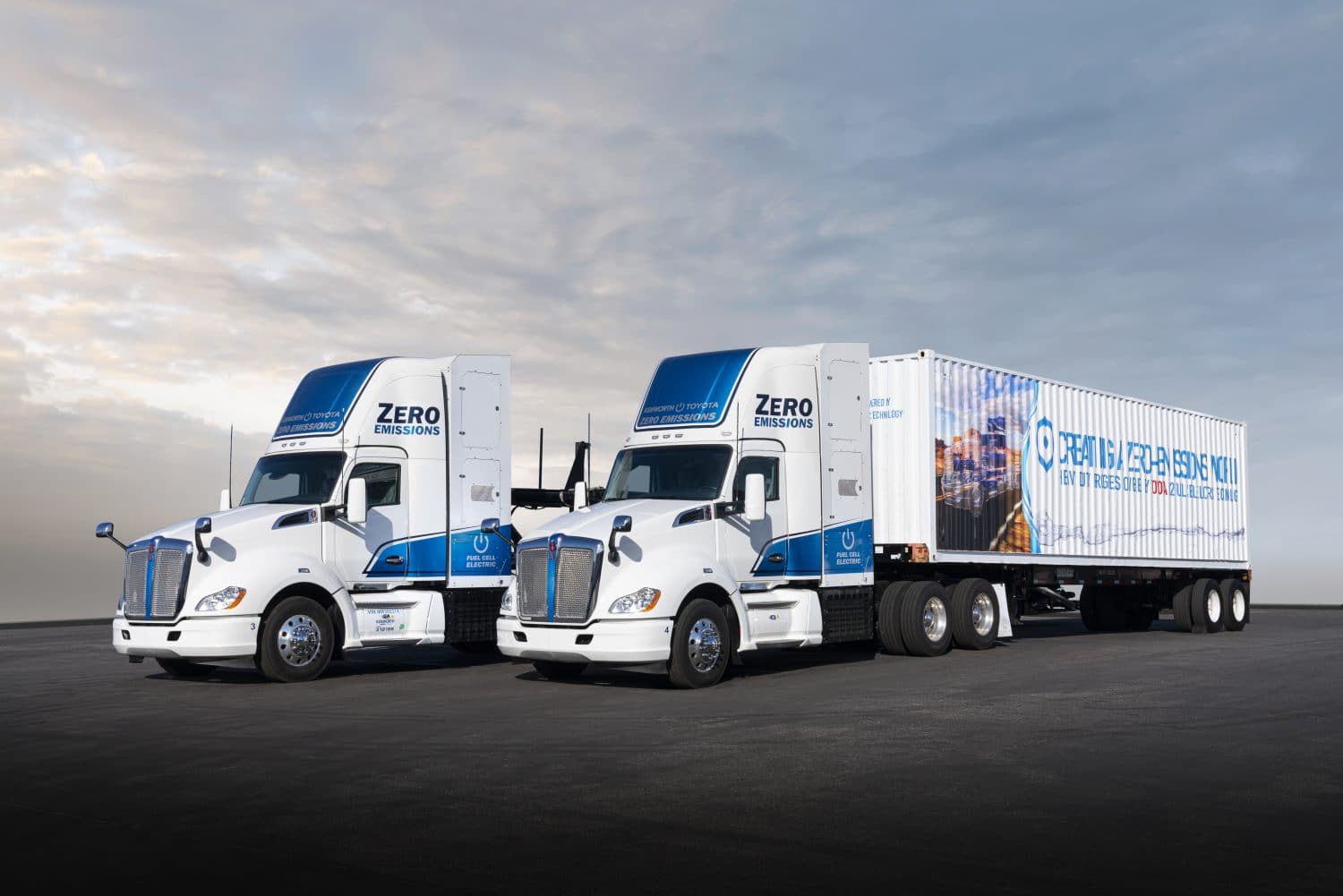
A recent report details the problems facing commercial fleet operators trying to meet clean-air targets while not disrupting their businesses. The report from Reuters.com details several commercial fleet operators who are looking to reduce emissions. However, for these fleets, the practical application of using electric trucks just doesn’t work, and hydrogen fuel cell trucks are seen as a potential solution.
Why does this matter? These fleets are critical to improving air quality since commercial operations make up the bulk of tailpipe emissions.
Why electric trucks don’t work for fleets
Many EV advocates see electric trucks as the no-brainer solution for fleets, and they see hydrogen as “fool cells,” borrowing Tesla CEO Elon Musk’s viewpoint.
With a fixed route and low demand for long-distance towing or hauling, an electric truck can work, and companies such as Amazon and Domino’s Pizza are demonstrating this on a daily basis. And these short-distance delivery fleets bolster EV advocate arguments. Yet that’s not the whole picture of the commercial market.
When it comes to long-haul trucking, electric trucks have proven to be ineffective. Of course, Tesla proves to be an exception to the rule for short-haul routes, like the Tesla semi is currently providing for Pepsi. That semi utilizes a specialized 750 kW “Mega Charger” to add 400 miles of range in an hour.
In general, however, to get more range in an electric truck, you need more batteries, which increases the weight of the truck and reduces overall hauling capacity and range. Then, you have the issue of even longer charging times with the more batteries. Finally, batteries are expensive, and with the rush to mine more lithium looking like it will take a while, supply is going to get even tighter, driving up demand and pricing.
The nut of the problem: If you buy an electric semi, you are looking at less capacity, more downtime for charging and a higher price. Many companies would then be faced with completely changing their business model to adapt to these issues.
Are hydrogen fuel cell trucks the better solution?
Transport companies are now looking for another solution, and this is where hydrogen comes into play. In a hydrogen fuel cell vehicle, you still have a battery and clean tailpipe emissions. It literally emits water vapor. The key difference is in the refueling times and weight.
When refueling hydrogen fuel cell trucks, the times are becoming similar to filling up a class 8 diesel semi, meaning operators would see no real disruption to their preplanned routes and stopping points.
Also, a hydrogen fuel cell is more energy dense than a straight battery electric vehicle (BEV), allowing for more range without having to add so much weight it drastically reduces the capability of the semi.
The problem with hydrogen fuel cell trucks, however, is the same one you’d encounter with a BEV: Infrastructure. The good news for both: According to the Reuters article, the U.S. Inflation Reduction Act provides subsidies for both hydrogen and BEV charging on high-traffic routes. But the better news for hydrogen: Adding infrastructure should be easier, and the actual refueling process is simpler and faster than charging.
For hydrogen, you could add a fuel line at most gas stations with another pump. The supply of hydrogen can be stored much like a gas or diesel and refueled with fueling trucks. Plus, hydrogen is the most abundant element on earth and isn’t a finite resource like lithium.
Finally, as Toyota recently stated, fuel cell technology enables automakers to spread the limited lithium supply to power more vehicles rather than spending a larger amount for a bigger EV battery.
It is worth noting Toyota is developing a hydrogen fuel cell kit for Kenworth (pictured in the feature image), using its existing Mirai fuel cell technology, General Motors is working on a midsize Chevy Colorado like hydrogen fuel cell for the military, and Honda has announced a CR-V hydrogen fuel cell for consumers.
The bottom line
The upsides to hydrogen are tremendous for commercial fleets, and these fleets will push the infrastructure to expand quickly, potentially much faster than charging infrastructure development due to cost and overall demand. Commercial operations use more resources than consumers, and our economy depends on them delivering their goods and services.
This isn’t to say straight BEVs won’t have their place as well. They do work in many urban areas — think downtown Chicago — and have their place in the automotive industry. It’s just that for most of the country and globally, long-distance hauling will need a different solution.
We need to realize there is more than one emissions solutions and figure out which vehicle is best suited for which solution. Then we need to make the infrastructure work.