
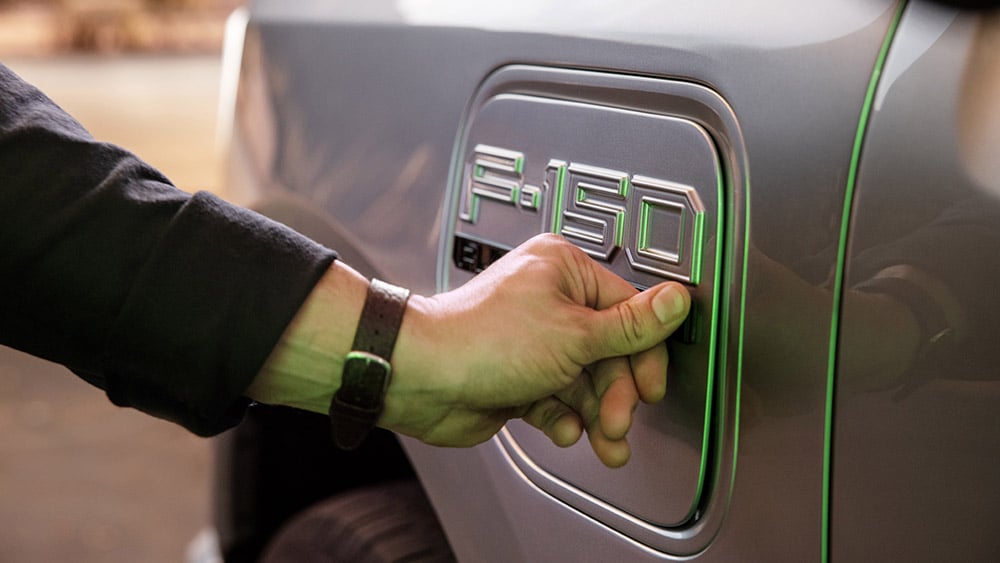
As one of the first electric trucks, the Ford F-150 Lightning has a lot of people curious about how it could fit in their lifestyles. A key part of the EV life is charging, which includes public fast chargers, a dedicated 220 volt outlet or even a 110 volt plug. I tried all three during the test week, and here’s what I found out about how much it costs to charge.
The worst way to charge the Ford F-150 Lightning
Let’s start off with the worst way to charge the truck, and this means the 110-volt plug.
The 110-volt plug is what you find in the wall of your home, and the mobile charger from Ford Motor Co. can utilize this power source to charge the electric truck. There’s only one big catch: the length of time it takes to charge.
In the case of this hook up, the onboard computer told me it would take 4 days to charge. Yeah, FOUR days.
This kind of charging adds 2 to 3 miles of range using 12 amps with a little more than 1 kW of power per hour. So, during the course of 4 days, that’s 96 kWh of power to fill the standard range battery with an estimated 240 miles of range. If you have an extended range battery, you are looking at 131 kWh of power for 320 miles of range.
If you decided to charge from empty to full and used the entire four days, you would multiply the kWh of power used by the cost per kWh in our area. In my area, I pay 15 cents per kWh. This means, empty to full on a standard-range truck, I’d spend $14.40 for a full “tank.”
Level 2 charging the better way to go
The better way to charge is going to be installing a dedicated circuit with a 220-volt plug and either a 50- or 60-amp breaker.
What does all that mean? And if you have a dryer outlet, why not just use that?
First, a dryer outlet is wired typically with No. 10 AWG wire with a 30-amp breaker. This could work IF you have the right plug end on your dryer outlet AND you have a way to run the wire from the truck to the outlet. However, you won’t get the full benefit of the 220-volt charging.
Why not? Ford’s mobile charger and at-home charging plug require 50 amps of service for the former and 60 amps of service for the latter. The 30-amp dryer outlet doesn’t provide that much power to charge. And before you ask, no, you can’t simply install a bigger breaker. The wire size determines how much power can flow from the breaker to the plug.
In order to make the dryer outlet work, you’d not only have to change breakers but also tear out all the old wire and replace it with new wire. Then you get to try to find an adapter if your plug doesn’t fit.
During my week of testing, I tried using the dryer plug to no avail and learned all the above as I scrambled to charge the truck.
Instead, I installed a dedicated 220-volt plug outside of my house with No. 6 AWG wire and a 50-amp breaker. This project cost about $550 at the local home improvement store with the bulk of the price being the wire. Luckily, I have a friend who is a licensed electrician, and he helped me wire it in exchange for a free lunch. This saved me $1,000 for labor.
The project took about a half day, and now the charging speed has turned into hours instead of days. From 50 to 100%, it took me 13 hours of charging, costing about $13 in electricity. I gained about 200 miles of range during that time. Ford says empty to full with 220-volt plug should run 13 to 20 hours.
What about fast charging?
The fastest charge route is using a public fast charger. But it’s also the most expensive.
Heading down to Colorado, I stopped four times to charge on a long road trip at fast chargers, which were located outside of Walmarts and grocery stores. So, I planned my stops around these chargers. Basically, it was pull up, plug in and then go shopping or have lunch. After about 30 minutes, it was back to the truck to keep driving.
For these chargers, it was adding 100 or so miles of range, about 40% more range, at 43 cents per kWh. This range was added in about 30 minutes of charging. The price? I spent $23.
The bottom line
I learned a lot during just a week of driving the Ford F-150 Lightning. First, you should always charge at home. Second, you can’t treat an electric truck like a gas truck and just drive it to empty then fill it at a public charger — that’s just too costly and there aren’t enough fast chargers out there. Finally, I learned living with the electric truck can be a big adjustment for some, and a small adjustment for others. I mean, if you live in the rural area like I do, the infrastructure isn’t there yet for the Lightning to be a daily driver. And, while the infrastructure in a city is better, that would pose its own set of problems.
Related posts: