
Before you attach anything to a hitch, make sure you understand the basics for personal truck towing like payload and towing limits to you can avoid fines or even a civil lawsuit.
You may think those only apply to commercial operators such as semi truck drivers and you’d be wrong. Police officers can enforce the same laws on towing limits on personal vehicles as well. The laws aren’t specific to just commercial vehicles.
Plus, lawyers can take negligent owners to court for overloading their trucks much the same way commercial trucking companies face lawsuits for accidents. There’s no legal difference.
The fact is you are legally responsible for knowing the limits of your truck much like a commercial operator.
Personal truck towing basics 101
Towing properly can be very complex at first with many new terms. In this article, I’ll assume you know what a hitch is, a ball (and know balls have different maximum towing weights), how to check your lights, cross your chains, etc…
Also, make sure you check your owner’s manual for instructions on whether or not you need a weight-distribution hitch. It is often needed for loads over 5,000 lbs.
Terms I will discuss include maximum towing capacity, payload, tongue weight, Gross Vehicle Weight Rating (GVWR) and Gross Combined Weight Rating (GCWR).
These will be for U.S. trucks as well. There are some difference such as in Europe where a 165 pound driver is included in the curb weight of the vehicle. That is often mistaken here in the U.S. and people think a truck’s payload includes a 150 pound driver, it does not.
Most Overlooked Towing Item
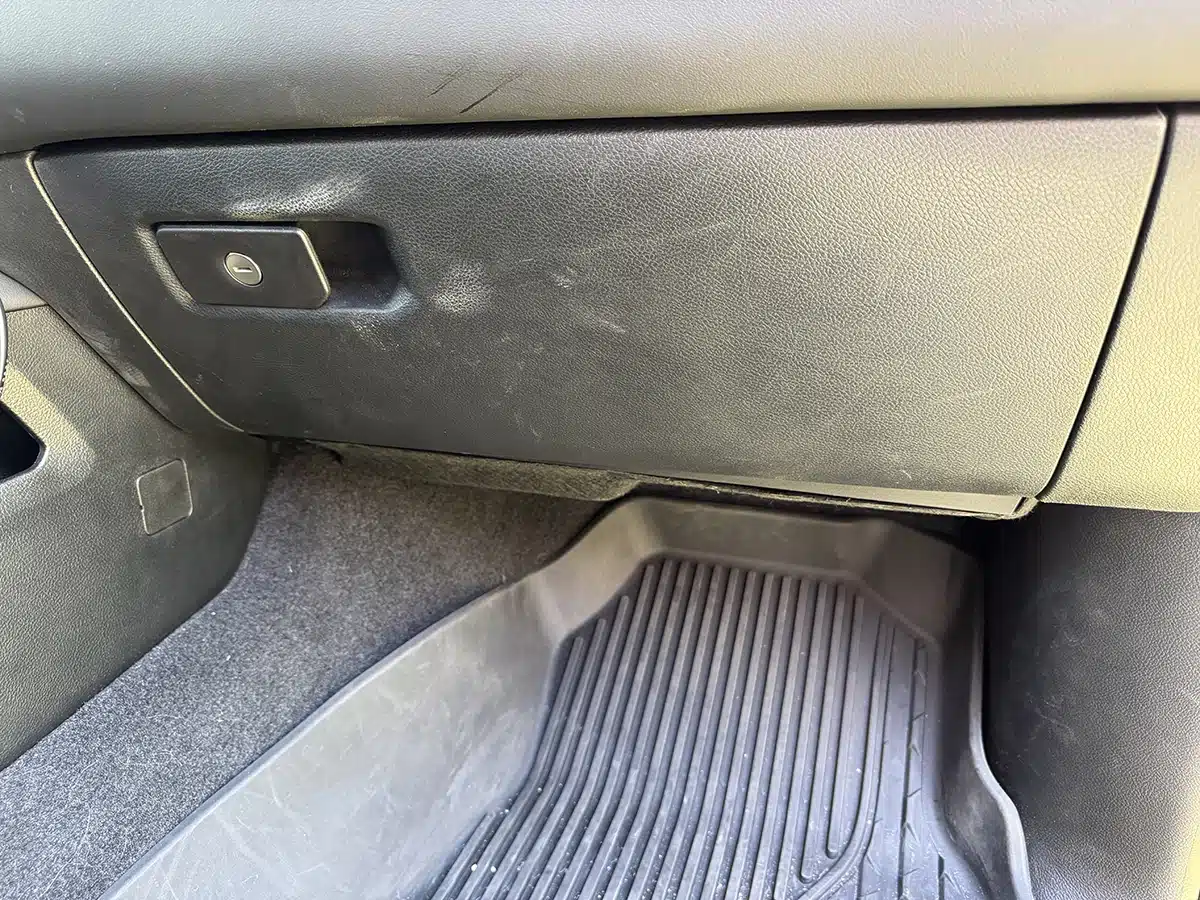
The first thing you need to check is the most overlooked item and it is often found in your glovebox.
No, it is not the owner’s manual, although, that is helpful as well, it is actually the truck registration.
When you registered your truck, you were asked how much weight you wanted to register the truck for when towing. This simple question can really trip people up including, as it turns out, myself.
For example, my 2025 Ram 1500 RHO I purchased this year to review, was registered for 3 tons or 6,000 lbs. That’s the legal limit of how much it can tow according to law enforcement. Yeah, guess who is heading back to the DMV to get a new registration? This guy. SMH.
Towing capacity of the truck
Next, you’ll need to research how much your truck can tow according to the manufacturer.
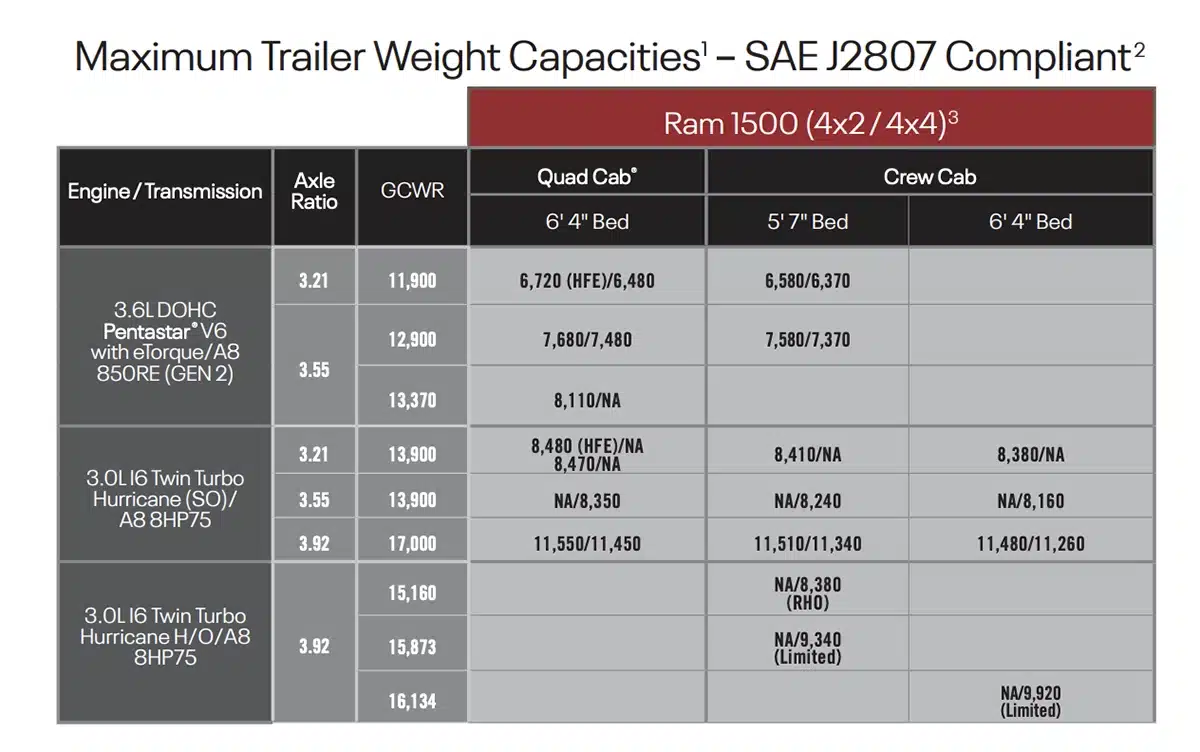
These days, it is pretty easy to find this information thanks to Google. Most manufacturers have towing charts where you find your truck based on cab size, bed length, engine and axle ratio.
This information can be found in the owner’s manual or on the sales sticker (aka Monroney label) and you can purchase a sales sticker for your truck if you don’t have one online as well.
Matching up your information, you should determine how much your truck can tow.
Going back to the 2025 RHO as an example, I have the 3.0-liter inline 6 Hurricane engine, a 3.92 rear axle ratio, a 5’7” bed, crew cab and 4WD. According to Ram trucks towing capacity chart, I can tow up to 8,380 lbs.
Payload of the truck
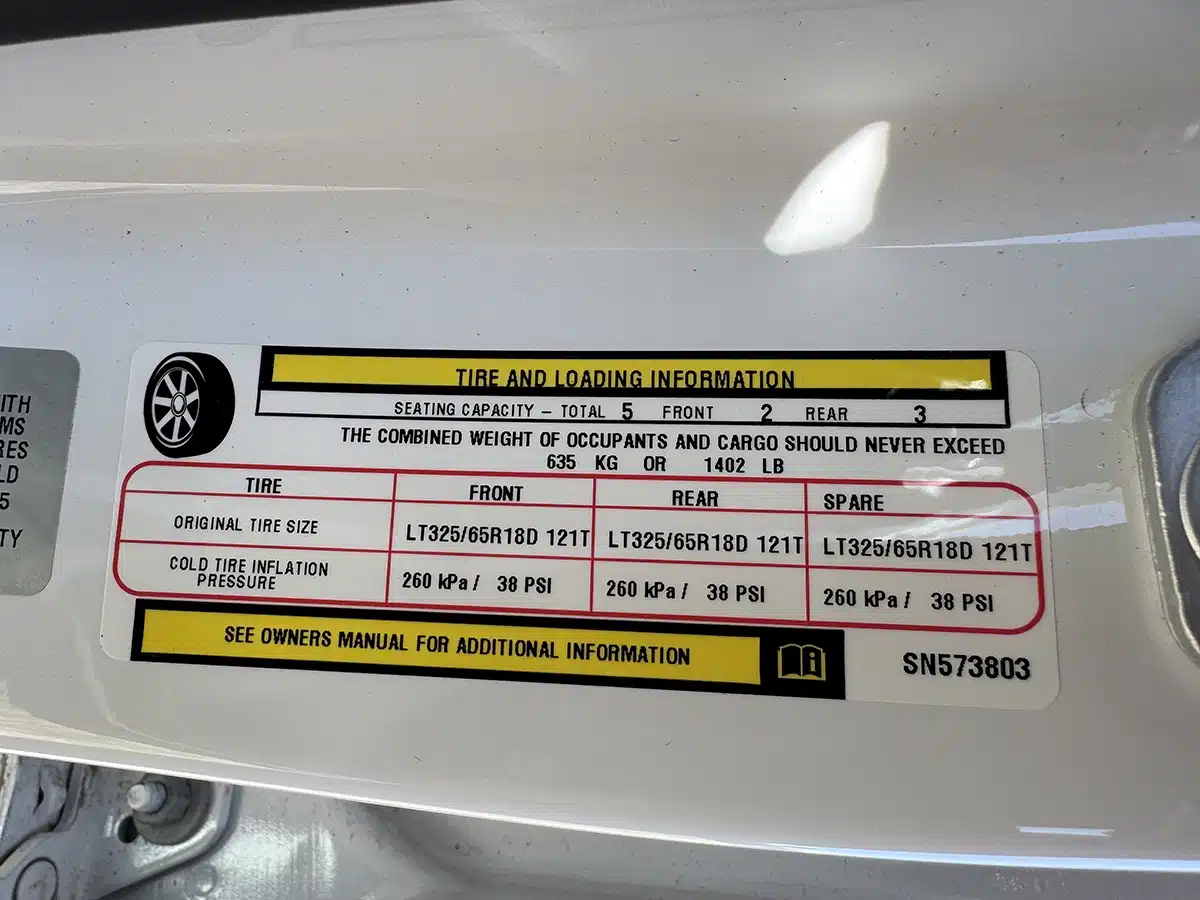
After you have the towing capacity, the next number you need to know is payload capacity. This number is found on the sticker affixed to the door jamb of the driver’s side door on all 2006 model year and newer vehicles and it is listed above where tire pressure is listed.
This number is also the one that is often misunderstood among many truck owners.
Payload is the manufacturer’s stated limit of how much weight you can add to the truck before you exceed what the truck can handle. It is calculated with a full tank of gas and does not include a 150 pound driver as stated above. The tank of gas is part of the curb weight or how much the truck weighs without any people or gear inside of it.
Once you surpass this number, you are putting additional stress on items like the drivetrain, brakes, steering, tires, powertrain, etc…
While not always accurate to the number, payload can be calculated by weighing the truck on a scale to determine the curb weight, make sure your tank is full, and subtracting this number from the GVWR.
GVWR? What is that?
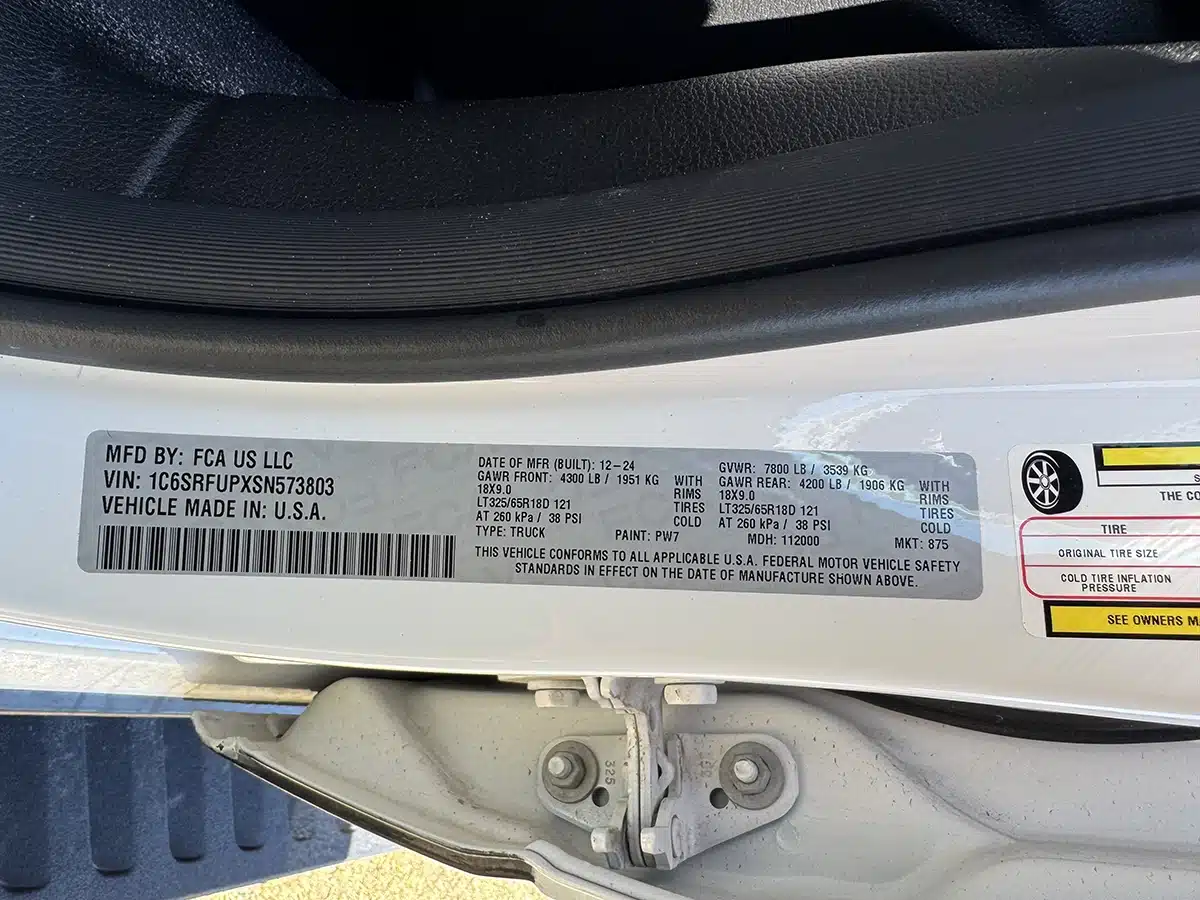
The GVWR is the maximum weight the truck can handle if you combine payload and curb weight as stated by the manufacturer. This information is also commonly found on a sticker on the door jamb. The sticker requirement for this goes back to 1959 when the Monroney act was passed creating the sales sticker.
A quick note. If you are fortunate to have a GM vehicle, they have a new sticker that is specific to your vehicle listing towing capacity, payload, GVWR and more. It is located between the doors and makes gathering information very simple.
Going back to the RHO, the sticker says the GWVR is 7,800 lbs. The other sticker shows my payload is 1,402 lbs. This means my truck weighs 6,398 lbs.
More on the truck weight and why it matters later.
Tongue weight matters as well
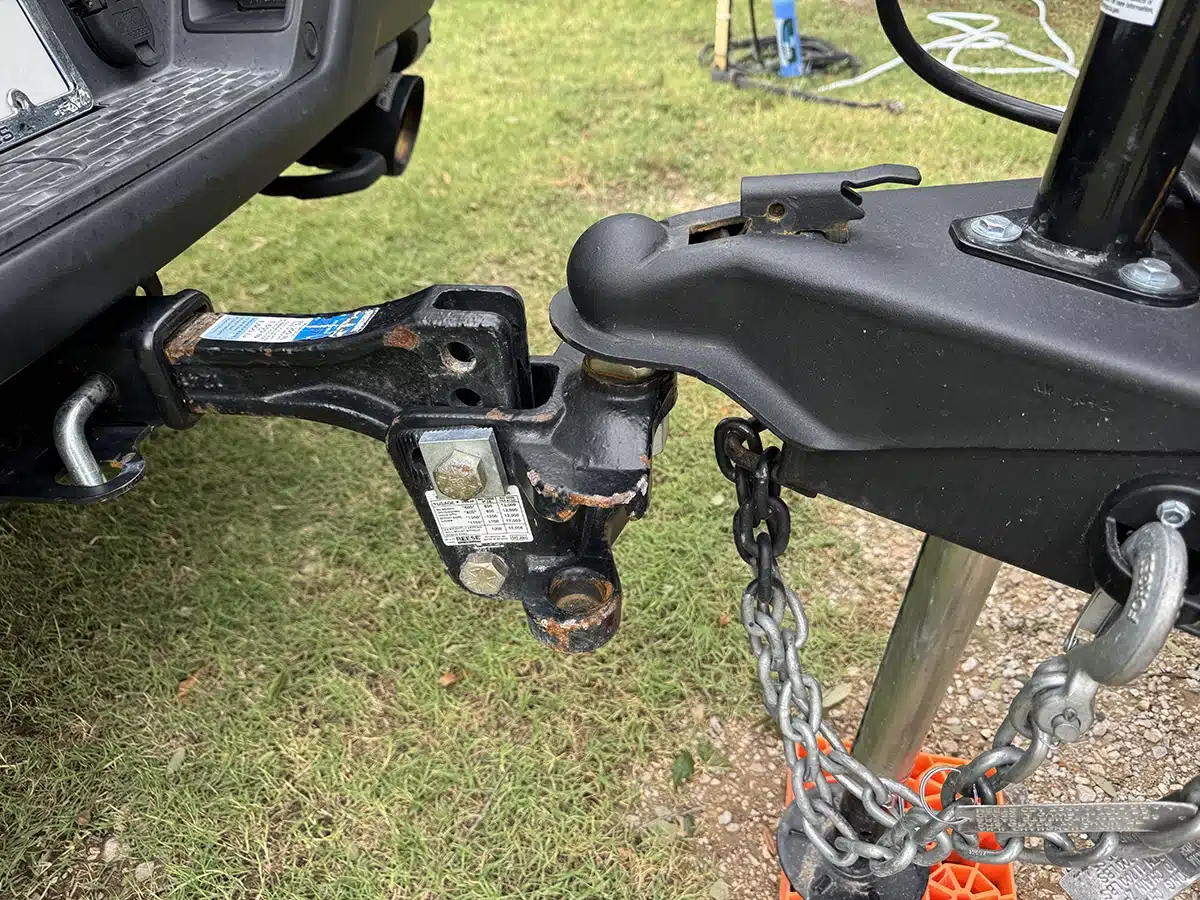
The other thing matters and affects payload is tongue weight. People get this wrong all the time.
Once you put a trailer, camper, boat or whatever on your hitch, you will notice the truck will start to sag. This is the result of the tongue weight pushing down on the truck.
First, it is normal. Second, it is very important.
When the truck sags, it is the visual representation of the transfer of weight from the trailer to the truck. You must account for this weight being added to the truck.
You do this by subtracting the tongue weight from the truck’s payload.
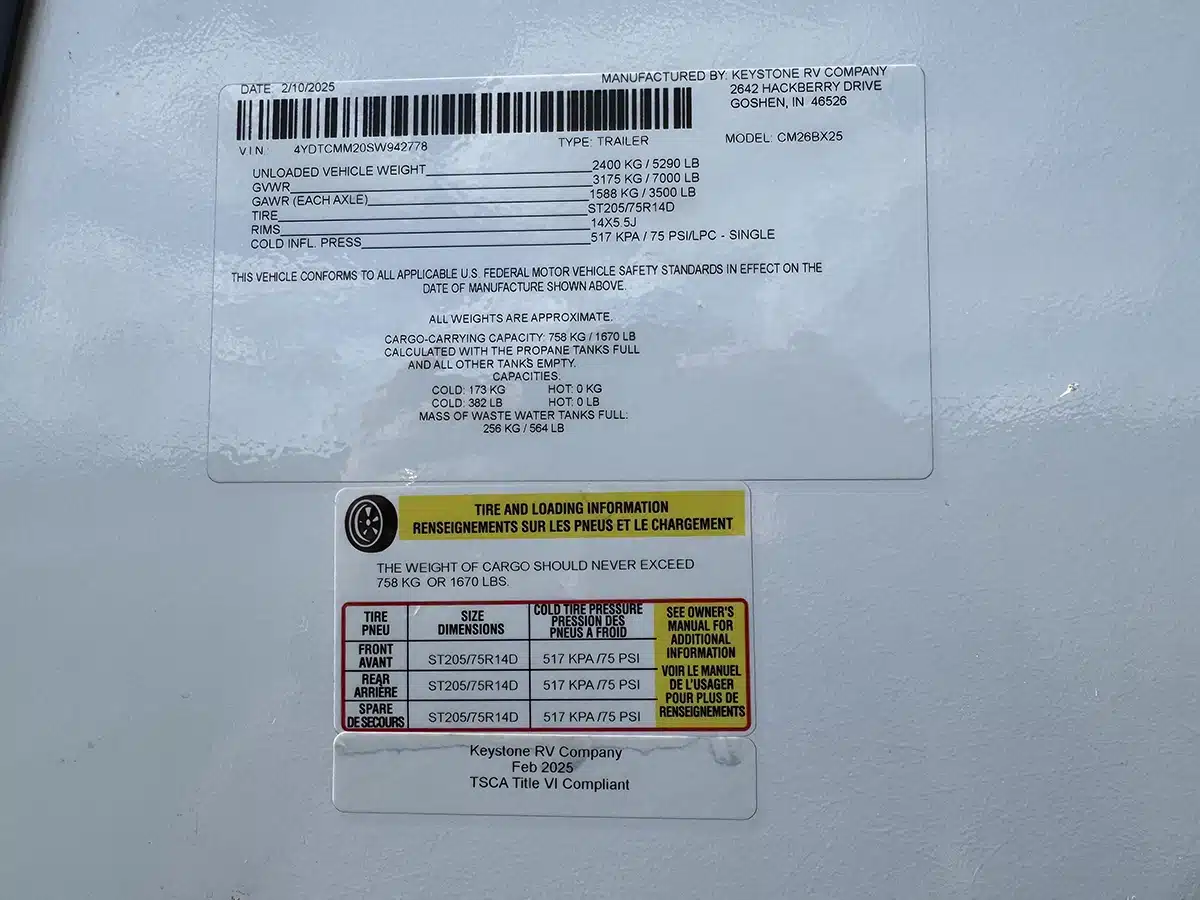
Some trailers have a tongue weight specified on the label attached to it and others don’t. The general rule of thumb is 10% of the trailer’s weight is the tongue weight.
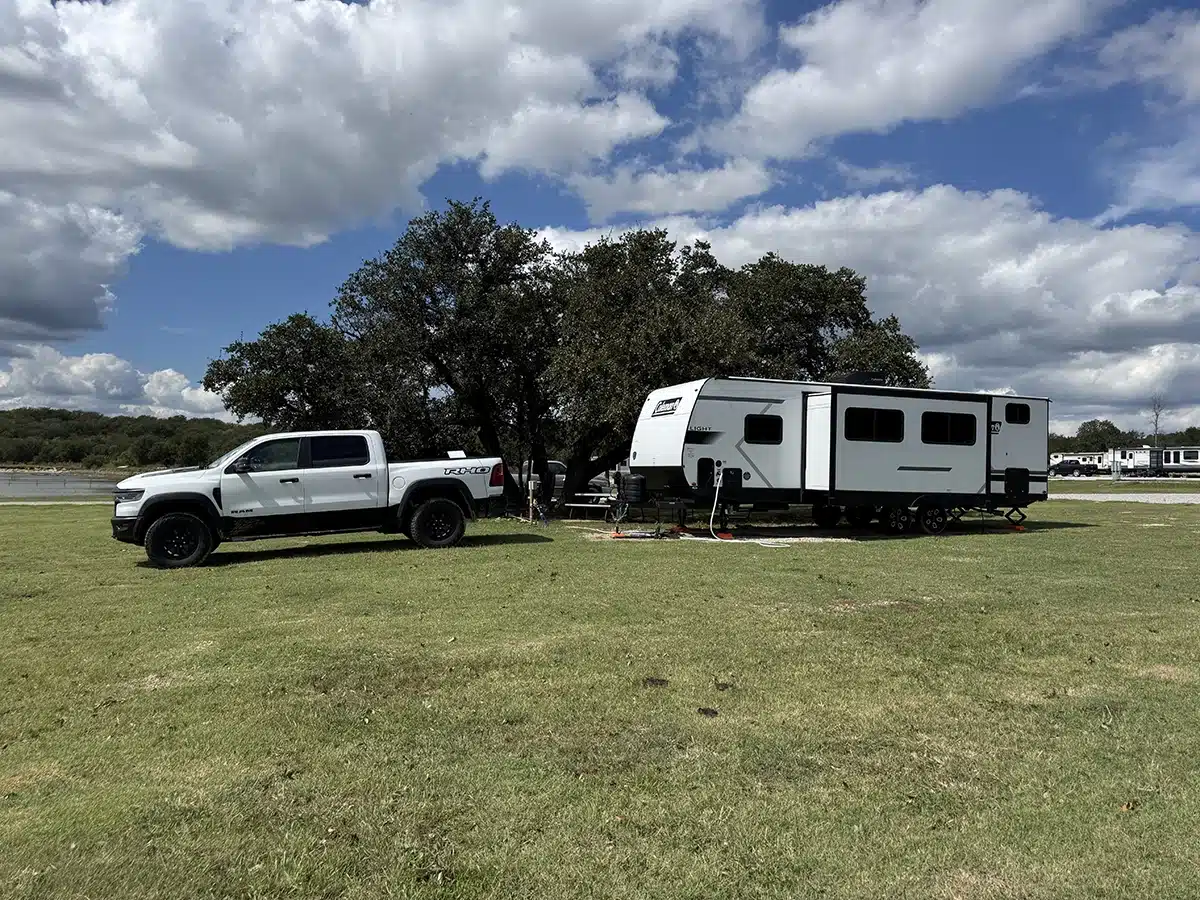
For example, I have a 30′ camper that weighs 5,300 lbs dry (empty weight). This means, when I attach this camper to the RHO, I’m adding 530 lbs of weight to the truck.
My payload math works like this: 1,402 – 530 – people – cargo in the truck (and the bed!) – drinks – cell phones – wallets, etc…
When I subtract the first two numbers, I’m left with 872 lbs. This means, if I’m carrying say 4 adults who all weigh 250 lbs, my truck is overloaded. Period.
Fortunately, my family includes two skinny teenage sons and combined we weigh around 750 lbs leaving us with around 100 lbs of additional weight we can carry in the truck.
What about GCWR?
I mentioned GCWR above and this is also an important number to know as well.
This number, found on the towing chart the manufacturer provides, is the combined weight of the truck and whatever you are towing.
Again, with the RHO, the GCWR is 15,160 lbs. This means the truck and the camper I own can’t exceed 15, 160 lbs.
Even if I were to load my camper up to its maximum capacity aka its “wet weight” of 7,100 lbs and add in, the truck’s maximum weight with a GVWR of 7,800 lbs, my combined weight of 14,900 lbs is below the GCWR. And that is maxed out.
Can you really face fines or be sued?
Finally, can you really face fines or be sued? Yes.
As you read above, full-size trucks can tow campers and be within their limits of GCWR. And most camper manufacturers are making lighter-weight models. Quite often, people will overload their truck’s payload, but stay below the truck’s GCWR. This will cause some sag and wear and tear on components, yet it often won’t lead to an accident.
Where things get tricky is in the case of slide-in campers or heavy-duty trucks. People quite often will go well beyond those limits and there was a pretty famous story last year of a Ram 3500 dually that snapped its frame from being overloaded with a slide-in camper. He was denied a warranty repair and the insurance company wasn’t inclined to help him much either. His story is one of a person who really didn’t know his numbers.
From a legal aspect, if a truck gets involved in an accident, much like any traffic accident, and it causes damage or harm, a police officer can issue a ticker and a lawyer could sue in civil court.
The kicker here is the towing piece. Some jurisdictions will call this offense “driving to endanger” or “reckless driving.”
What does a lawyer need to prove in a truck towing accident?
A lawyer needs to prove four things: duty, breach of duty, causation and damages.
First, duty. This is your duty to operate the truck in a safe manner on public roads.
Second, breach of duty. This means you operated the vehicle negligently.
Third, causation. This means your negligence caused the truck accident.
Fourth, damages. This means you caused harm to another person or property due to your negligence.
If you were found to have caused the accident and the accident report is the proof, then duty, causation and damages are pretty simple.
The fourth item, breach of duty, is all the lawyer really has to prove. All the attorney needs to show is photos or websites showing the towing information above stating the towing capacity, payload information, GCWR, GVWR of the truck and trailer you were towing.
They will make the case the truck was overloaded through the data, whether you knew it or not doesn’t really matter, since you are legally responsible. The jury will see the injured person and odds are you aren’t going to win.






No replies yet
Loading new replies...
Administrator
Join the full discussion at the Forum Pickuptrucktalk →